
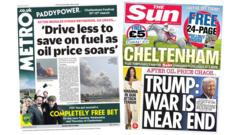
The Papers: 'Drive less to save on fuel' and 'War is near end'
#fuel prices #UK economy #Iran conflict #Trump commentary #inflation #energy markets #newspaper headlines
📌 Key Takeaways
- Experts warn UK fuel prices could reach £2 per litre
- Trump claims Iran war is nearing its end
- Both stories dominated Tuesday's newspaper headlines
- Fuel price concerns stem from multiple economic factors
📖 Full Retelling
🏷️ Themes
Economic concerns, Geopolitical conflicts, Media headlines
📚 Related People & Topics

BBC News (British TV channel)
British 24-hour television news channel
The BBC News channel is a British free-to-air public broadcast television news channel owned and operated by the BBC. The channel is based at and broadcasts from Broadcasting House in the West End of London from which it is anchored during British daytime, with overnight broadcasts anchored from Was...

Economy of the United Kingdom
The United Kingdom has a highly developed social market economy. From 2017 to 2025 it has been the sixth-largest national economy in the world measured by nominal gross domestic product (GDP), tenth-largest by purchasing power parity (PPP), and about 21st by nominal GDP per capita, constituting 3.38...
List of wars involving Iran
This is a list of wars involving the Islamic Republic of Iran and its predecessor states. It is an unfinished historical overview.
Entity Intersection Graph
Connections for BBC News (British TV channel):
Mentioned Entities
Deep Analysis
Why It Matters
This news is important as it highlights two critical issues affecting people's daily lives and international relations. The potential surge in UK fuel prices to £2 per liter would directly impact consumers and businesses, potentially worsening the cost of living crisis. Meanwhile, Trump's statement about the Iran conflict nearing its end demonstrates his continued influence on global discourse and could impact geopolitical stability and market reactions.
Context & Background
- The UK has been experiencing significant inflation pressures in recent years, with energy prices being a major contributor to the cost of living crisis
- Global energy markets have been volatile due to the COVID-19 pandemic, supply chain disruptions, and the transition to renewable energy
- The US and Iran have had a long history of tensions, particularly since the US withdrew from the Iran nuclear deal in 2018 under the Trump administration
- Donald Trump continues to be a dominant figure in US politics despite losing the 2020 election, frequently making statements that influence public discourse
- Fuel prices in the UK have been rising steadily, with the current average already being significantly higher than a few years ago
What Happens Next
If fuel prices continue to rise, we can expect increased pressure on the UK government to provide relief measures, potentially through fuel subsidies or tax cuts. The Bank of England may need to consider the impact of rising energy prices on its monetary policy decisions. Trump's statement about the Iran conflict could lead to diplomatic developments or market reactions, though without concrete evidence, specific outcomes are difficult to predict. Consumers may adjust their behavior by driving less, carpooling, or using public transportation more frequently.
Frequently Asked Questions
The potential price hike is attributed to geopolitical tensions affecting oil supplies, post-pandemic demand recovery, and the ongoing transition toward renewable energy sources.
Such a price increase would significantly impact transportation costs, potentially leading to higher prices for goods and services, increased inflation, and reduced consumer spending power.
The article doesn't mention any concrete evidence or timelines provided by Trump for his assertion that the Iran war is approaching its end.
Consumers might respond by driving less, seeking more fuel-efficient vehicles, using public transportation more frequently, or forming carpool arrangements to reduce fuel expenses.