
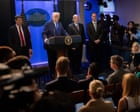
The supreme court’s tariffs ruling puts Trump on notice with a bloody nose
#Supreme Court #Donald Trump #Tariffs #Executive Power #Constitution #John Roberts #Neil Gorsuch #Amy Coney Barrett
📌 Key Takeaways
- Supreme Court ruled Trump's tariffs unconstitutional in 6-3 decision
- Two of Trump's own appointees joined the majority against him
- Court asserted that only Congress has power to levy taxes
- Trump responded with personal attacks on the justices
📖 Full Retelling
🏷️ Themes
Executive Power, Judicial Review, Trade Policy
📚 Related People & Topics
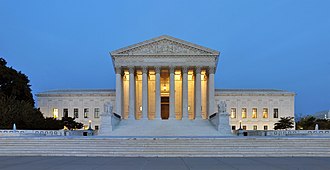
Supreme court
Highest court in a jurisdiction
In most legal jurisdictions, a supreme court, also known as a court of last resort, apex court, high (or final) court of appeal, and court of final appeal, is the highest court within the hierarchy of courts. Broadly speaking, the decisions of a supreme court are binding on all other courts in a nat...

Constitution
Fundamental principles that govern a state
A constitution, or supreme law, is the aggregate of fundamental principles or established precedents that constitute the legal basis of a polity, organization or other type of entity, and commonly determines how that entity is to be governed. When these principles are written down into a single docu...
Executive Power
2003 political thriller novel by Vince Flynn
Executive Power is a thriller novel by Vince Flynn, and the sixth to feature Mitch Rapp, an American agent that works for the CIA as an operative for a covert counter terrorism unit called the "Orion Team".

Tariff
Goods import or export tax
A tariff or import tax is a duty imposed by a national government, customs territory, or supranational union on imports of goods and is paid by the importer. Exceptionally, an export tax may be levied on exports of goods or raw materials and is paid by the exporter. Besides being a source of revenue...

Donald Trump
President of the United States (2017–2021; since 2025)
Donald John Trump (born June 14, 1946) is an American politician, media personality, and businessman who is the 47th president of the United States. A member of the Republican Party, he served as the 45th president from 2017 to 2021. Born into a wealthy New York City family, Trump graduated from the...
Entity Intersection Graph
Connections for Supreme court:
Mentioned Entities
Deep Analysis
Why It Matters
The Supreme Court's decision invalidating President Trump's tariffs marks a rare check on executive power, reinforcing the constitutional role of Congress in taxation. It signals that the Court is willing to confront the president on overreach, affecting trade policy and the balance of powers.
Context & Background
- Trump used tariffs as a tool of foreign policy
- The Court has issued 24 emergency rulings favoring Trump
- The ruling was a 6-3 decision with Chief Justice Roberts authoring
- Two of Trump's nominees, Gorsuch and Barrett, voted with the majority
- The decision limits the president's use of the International Emergency Economic Powers Act
What Happens Next
The ruling may prompt Trump to seek alternative legislative routes for tariffs, but the Court has signaled limits on executive action. Congress could respond by tightening oversight or passing new trade legislation. Legal scholars will analyze the decision for future checks on presidential power.
Frequently Asked Questions
The Court held that the International Emergency Economic Powers Act does not grant the president authority to impose tariffs, which are taxes reserved to Congress.
The decision was a 6-3 split with Chief Justice Roberts and two of Trump's appointees joining three liberal justices, a rare coalition.
It removes a key tool Trump used to pressure allies and adversaries, forcing him to rely on congressional approval for future tariffs.