
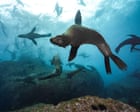
‘There’s biological treasure here’: Chile’s endemic seals gain protection with new marine park
📖 Full Retelling
<p>Sixty years after the discovery of a colony of Juan Fernández fur seals, previously thought to be extinct, a landmark agreement extends ‘no take’ zone around the wildlife-rich archipelago</p><p>Six decades ago, pioneering oceanographer and conservationist <a href="https://www.theguardian.com/profile/sylvia-earle">Sylvia Earle</a> made a bittersweet discovery while diving off Chile’s oceanic islands with the US National Science Foundation vessel, the Anton Bruun.
Entity Intersection Graph
No entity connections available yet for this article.
Original Source
The discovery of a colony of Juan Fernández fur seals on Robinson Crusoe Island marked the start of efforts to increase protections for the area. Photograph: Andy Mann/Blue Marine Foundation Sixty years after the discovery of a colony of Juan Fernández fur seals, previously thought to be extinct, a landmark agreement extends ‘no take’ zone around the wildlife-rich archipelago By Karen McVeigh S ix decades ago, pioneering oceanographer and conservationist Sylvia Earle made a bittersweet discovery while diving off Chile’s oceanic islands with the US National Science Foundation vessel, the Anton Bruun. She found the remains of a baby fur seal, one of the world’s most isolated aquatic mammals. Endemic to the Juan Fernández archipelago, in the Pacific Ocean, and once prized for its fur and meat, the species, Arctocephalus philippii , was believed to have been hunted to extinction in the 19th century. But, Earle said: “A baby must have a mum and dad somewhere.” A year after her find, a small colony of 20 endemic fur seals was confirmed on Robinson Crusoe Island, one of the archipelagos’ three islands, named after Daniel Defoe’s fictionalised tale of the real-life sailor Alexander Selkirk, who was marooned there from 1704 to 1709. The discovery was, she says, a “message of hope” and with it “the beginning of the turn-around” to protect the archipelago, a haven for endemic wildlife and a biological hotspot, against other human-made threats including industrial fishing and the climate crisis. Today, after decades of action by islanders and conservationists, including Earle who described it as a critical “Hope Spot” to protect marine life, the almost obliterated seal population has made a remarkable recovery. An estimated 200,000 fur seals now live around the islands, “returning them to their previous role as key members of the ecosystem” says Earle, now 90, who returned to the island to dive in December 2025. Last week, Earle and the 1,000-strong community of mainly lobster ...
Read full article at source