
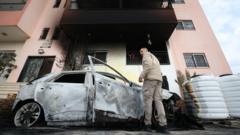
'There's no safety anymore': Palestinians warn of expanding West Bank settler violence
#Palestinians #West Bank #settler violence #safety #conflict #escalation #security
📌 Key Takeaways
- Palestinians report increasing settler violence in the West Bank, creating widespread fear.
- The violence is described as expanding, indicating a growing trend or escalation.
- Residents feel a loss of safety and security in their daily lives.
- The situation highlights ongoing tensions in the Israeli-Palestinian conflict.
📖 Full Retelling
🏷️ Themes
Settler Violence, West Bank Conflict
📚 Related People & Topics

Palestinians
Arab ethnonational group of the Levant
Palestinians (Arabic: الفلسطينيون, romanized: al-Filasṭīniyyūn) are an Arab ethnonational group native to the Levantine region of Palestine. They represent a highly homogeneous community who share a cultural and ethnic identity, speak Palestinian Arabic and share close religious, linguistic, and cul...

West Bank
Palestinian territory occupied by Israel
The West Bank is on the western bank of the Jordan River and is the larger of the two Palestinian territories (the other being the Gaza Strip) that make up the State of Palestine. A landlocked territory near the coast of the Mediterranean Sea in West Asia's Levant region, it is bordered by Jordan an...
Entity Intersection Graph
Connections for Palestinians:
Mentioned Entities
Deep Analysis
Why It Matters
This news highlights escalating violence against Palestinians in the West Bank, which threatens regional stability and human rights. It affects Palestinian civilians facing displacement and insecurity, Israeli settlers involved in or impacted by the violence, and international actors trying to mediate peace. The situation undermines prospects for a two-state solution and could fuel broader conflict, drawing in neighboring countries and global powers.
Context & Background
- The West Bank has been occupied by Israel since the 1967 Six-Day War, with settlements considered illegal under international law.
- Settler violence has historically increased during periods of Israeli-Palestinian tension, such as the Gaza conflicts or political shifts.
- The Oslo Accords in the 1990s divided the West Bank into areas of Palestinian and Israeli control, but settlements have expanded since.
- Recent years have seen a rise in far-right influence in Israeli politics, leading to policies that some argue encourage settler expansion.
- Palestinian authorities have limited control in parts of the West Bank, relying on Israeli security forces who are often criticized for not protecting Palestinians adequately.
What Happens Next
In the short term, expect increased international condemnation and potential UN resolutions addressing the violence. Over the next few months, there may be heightened Israeli military operations in the West Bank, possibly leading to more clashes. Long-term, if violence continues, it could derail peace efforts and trigger broader regional instability, with possible interventions by groups like Hamas or Hezbollah.
Frequently Asked Questions
Settler violence is often driven by ideological beliefs, security concerns, and political support from some Israeli factions. It tends to spike during periods of heightened Israeli-Palestinian conflict or when settlement expansion is promoted by government policies.
Expanding settler violence undermines trust and makes territorial compromises more difficult, as it leads to Palestinian displacement and hardens positions on both sides. It complicates negotiations by creating facts on the ground that are hard to reverse.
Countries like the U.S. and EU members often condemn the violence and may impose sanctions or diplomatic pressure, but their influence is limited by domestic politics in Israel and the complex nature of the conflict. UN agencies document abuses but lack enforcement power.
Israeli security forces sometimes intervene, but critics argue they are insufficiently proactive in protecting Palestinians and prosecuting settlers. The response varies based on political will and the specific incidents involved.
Palestinians face displacement, loss of property, physical harm, and psychological trauma, which disrupts livelihoods and access to services like healthcare and education. This exacerbates poverty and deepens cycles of violence.
Yes, if violence escalates, it could trigger responses from Palestinian militant groups or draw in neighboring countries, potentially sparking a broader conflict. However, many actors currently seek to avoid large-scale war due to economic and political costs.