
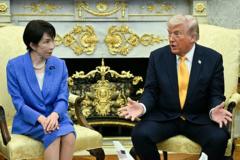
Trump compares attack on Iran to Pearl Harbor in meeting with Japanese PM
#Trump #Iran #Pearl Harbor #Japan #Middle East #Military #Tensions
📌 Key Takeaways
- Trump compared a potential attack on Iran to the Pearl Harbor attack during a meeting with Japan's Prime Minister.
- The analogy was made in discussions about Middle East tensions and military strategy.
- The comparison drew historical parallels between past and present geopolitical conflicts.
- The meeting highlighted U.S.-Japan relations and shared security concerns.
📖 Full Retelling
🏷️ Themes
Geopolitics, Military Strategy
📚 Related People & Topics

Pearl Harbor
Harbor on the island of Oahu, Hawaii
Pearl Harbor is a lagoon harbor on the island of Oʻahu, Hawaii, United States, west of Honolulu. It was often visited by the naval fleet of the United States before it was acquired from the Hawaiian Kingdom by the U.S. with the signing of the Reciprocity Treaty of 1875. Much of the harbor and surrou...

Japan
Country in East Asia
Japan is an island country in East Asia. Located in the Pacific Ocean off the northeast coast of the Asian mainland, it is bordered to the west by the Sea of Japan and extends from the Sea of Okhotsk in the north to the East China Sea in the south. The Japanese archipelago consists of four major isl...

Iran
Country in West Asia
# Iran **Iran**, officially the **Islamic Republic of Iran** and historically known as **Persia**, is a sovereign country situated in West Asia. It is a major regional power, ranking as the 17th-largest country in the world by both land area and population. Combining a rich historical legacy with a...

Middle East
Transcontinental geopolitical region
The Middle East is a geopolitical region encompassing the Arabian Peninsula, Egypt, Iran, Iraq, the Levant, and Turkey. The term came into widespread usage by Western European nations in the early 20th century as a replacement of the term Near East (both were in contrast to the Far East). The term ...

Donald Trump
President of the United States (2017–2021; since 2025)
Donald John Trump (born June 14, 1946) is an American politician, media personality, and businessman who is the 47th president of the United States. A member of the Republican Party, he served as the 45th president from 2017 to 2021. Born into a wealthy New York City family, Trump graduated from the...
Entity Intersection Graph
Connections for Pearl Harbor:
Mentioned Entities
Deep Analysis
Why It Matters
This comparison matters because it draws a parallel between a historical attack on the U.S. and a contemporary geopolitical conflict, potentially framing Iran as an aggressor similar to Imperial Japan. It affects U.S.-Iran relations by escalating rhetorical tensions, impacts Japan's diplomatic position as a U.S. ally with historical sensitivities, and influences global perceptions of Middle East conflicts. The analogy could shape policy discussions about military responses and alliances in volatile regions.
Context & Background
- Pearl Harbor was a surprise military strike by Imperial Japan against the U.S. naval base in Hawaii on December 7, 1941, killing over 2,400 Americans and leading to U.S. entry into World War II.
- Iran and the U.S. have had tense relations since the 1979 Iranian Revolution, with recent conflicts including the 2020 U.S. drone strike that killed Iranian General Qasem Soleimani and Iranian-backed attacks on U.S. forces.
- Japan has maintained a pacifist constitution since WWII but has strengthened its military alliance with the U.S. under Prime Minister Fumio Kishida, while navigating delicate relations with Middle Eastern nations for energy security.
What Happens Next
Japan may issue diplomatic statements clarifying its position on Middle East conflicts to balance its U.S. alliance with regional partnerships. The U.S. could face increased scrutiny over its Iran policy ahead of elections, with potential for escalated rhetoric or military posturing. International bodies like the UN may address concerns about inflammatory historical comparisons in diplomacy.
Frequently Asked Questions
The comparison likely aims to frame Iran as a historical aggressor to justify U.S. military or diplomatic actions, drawing on Pearl Harbor's symbolism of unprovoked attack. It may also resonate with domestic audiences familiar with WWII narratives.
Japan may diplomatically distance itself from the analogy due to its pacifist postwar identity and need to maintain stable relations with Iran for oil imports. Japanese leaders often avoid historical references that could revive wartime tensions.
Yes, such comparisons typically harden diplomatic positions by casting Iran as an existential threat, making compromise more difficult. It may empower hardliners in Iran who view the U.S. as hostile.
Most historians would note key differences: Pearl Harbor was a direct state-on-state attack, while modern Iran-U.S. conflicts often involve proxies or indirect actions. The analogy oversimplifies complex Middle East dynamics.