
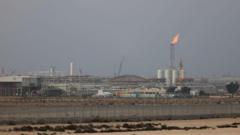
Trump says US 'knew nothing' about Israel's attack on major Iran gas field
#Trump #Israel #Iran #gas field attack #US foreign policy #Middle East conflict #energy infrastructure
📌 Key Takeaways
- Former President Trump claims the US had no prior knowledge of Israel's attack on Iran's major gas field.
- The attack targeted a significant Iranian energy infrastructure asset.
- Trump's statement distances the US from direct involvement in the military action.
- The incident highlights ongoing tensions between Israel and Iran in the region.
🏷️ Themes
Geopolitical Tensions, Energy Security
📚 Related People & Topics
Foreign policy of the United States
According to its 2025 National Security Strategy, the officially stated goals of the foreign policy of the United States of America are to ensure US preeminence in the Western Hemisphere, to "halt and reverse the ongoing damage that foreign actors inflict on the American economy while keeping the In...

Iran
Country in West Asia
# Iran **Iran**, officially the **Islamic Republic of Iran** and historically known as **Persia**, is a sovereign country situated in West Asia. It is a major regional power, ranking as the 17th-largest country in the world by both land area and population. Combining a rich historical legacy with a...

List of modern conflicts in the Middle East
List of Middle Eastern conflicts since 1914
This is a list of modern conflicts ensuing in the geographic and political region known as the Middle East. The "Middle East" is traditionally defined as the Fertile Crescent (Mesopotamia), Levant, and Egypt and neighboring areas of Arabia, Anatolia and Iran. It currently encompasses the area from E...

Israel
Country in West Asia
Israel, officially the State of Israel, is a country in the Southern Levant region of West Asia. It is bordered by Lebanon to the north, Syria to the northeast, Jordan to the east, and Egypt to the southwest. Israel occupies the West Bank and the Gaza Strip of the Palestinian territories, as well as...

Donald Trump
President of the United States (2017–2021; since 2025)
Donald John Trump (born June 14, 1946) is an American politician, media personality, and businessman who is the 47th president of the United States. A member of the Republican Party, he served as the 45th president from 2017 to 2021. Born into a wealthy New York City family, Trump graduated from the...
Entity Intersection Graph
Connections for Foreign policy of the United States:
Mentioned Entities
Deep Analysis
Why It Matters
This statement matters because it clarifies the United States' position regarding a significant military action against Iran's energy infrastructure, potentially reducing immediate escalation risks between the U.S. and Iran. It affects U.S.-Israel relations by creating distance from Israel's unilateral action, while also impacting global energy markets due to attacks on critical gas infrastructure. The declaration influences diplomatic calculations for European and Middle Eastern nations navigating tensions between Iran and Israel.
Context & Background
- The U.S. and Israel have historically maintained close military and intelligence cooperation, though occasional policy disagreements occur.
- Iran's South Pars gas field is the world's largest natural gas field, shared with Qatar, and crucial to Iran's energy exports and domestic supply.
- Tensions between Iran and Israel have escalated in recent years through proxy conflicts and direct attacks, including suspected Israeli strikes on Iranian nuclear and military sites.
- The Biden administration has pursued diplomatic engagement with Iran while maintaining sanctions, creating complex U.S. policy toward Iranian infrastructure.
What Happens Next
Iran will likely issue formal diplomatic protests and consider retaliatory measures against Israeli interests regionally. International energy markets may see increased volatility as attacks on critical infrastructure raise supply concerns. The U.S. Congress will probably hold hearings examining intelligence sharing protocols with Israel following this incident.
Frequently Asked Questions
Israel likely targeted Iran's energy infrastructure to pressure Tehran economically and demonstrate capability to strike critical assets, possibly in retaliation for Iranian support of militant groups or nuclear program advancement. Such attacks aim to degrade Iran's revenue sources and strategic capabilities.
The statement creates deliberate distance between U.S. and Israeli actions, suggesting Israel acted independently without U.S. approval or coordination. This maintains U.S. deniability while potentially straining intelligence-sharing norms between the two allies.
Attacks on major gas infrastructure typically increase market volatility and risk premiums, though the South Pars field's operational status will determine actual supply impact. Regional instability generally pushes energy prices upward due to transportation and security concerns.
While escalatory, Iran's response will likely be calculated to avoid full-scale war, possibly through proxy attacks or cyber operations. The U.S. distancing itself reduces immediate superpower confrontation risks, but miscalculation remains possible given tense regional dynamics.