
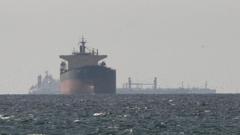
Trump urges UK and other nations to send warships to Strait of Hormuz
#Trump #UK #warships #Strait of Hormuz #maritime security #oil transit #international relations
📌 Key Takeaways
- Trump calls for UK and other nations to deploy warships to the Strait of Hormuz.
- The request aims to bolster maritime security in the strategic waterway.
- This move is part of broader efforts to address regional tensions.
- The Strait of Hormuz is a critical global oil transit route.
📖 Full Retelling
🏷️ Themes
International Security, Geopolitics
📚 Related People & Topics

Strait of Hormuz
Strait between the Gulf of Oman and the Persian Gulf
The Strait of Hormuz ( Persian: تنگهٔ هُرمُز Tangeh-ye Hormoz , Arabic: مَضيق هُرمُز Maḍīq Hurmuz) is a strait between the Persian Gulf and the Gulf of Oman. It provides the only sea passage from the Persian Gulf to the open ocean and is one of the world's most strategically important choke points. ...

United Kingdom
Country in northwestern Europe
The United Kingdom of Great Britain and Northern Ireland, commonly known as the United Kingdom (UK) or Britain, is a country in northwestern Europe, off the coast of the continental mainland. It comprises England, Scotland, Wales and Northern Ireland, with a population of over 69 million in 2024. Th...

Donald Trump
President of the United States (2017–2021; since 2025)
Donald John Trump (born June 14, 1946) is an American politician, media personality, and businessman who is the 47th president of the United States. A member of the Republican Party, he served as the 45th president from 2017 to 2021. Born into a wealthy New York City family, Trump graduated from the...
Entity Intersection Graph
Connections for Strait of Hormuz:
Mentioned Entities
Deep Analysis
Why It Matters
This development matters because the Strait of Hormuz is the world's most critical oil transit chokepoint, with about 20% of global oil consumption passing through daily. Trump's call for international naval presence directly affects global energy security and could escalate tensions with Iran, which has threatened to close the strait. This impacts oil-importing nations, shipping companies, and global markets that rely on stable energy supplies from the Middle East.
Context & Background
- The Strait of Hormuz is a narrow waterway between Iran and Oman that connects Persian Gulf oil producers with global markets
- Tensions have escalated since 2018 when the U.S. withdrew from the Iran nuclear deal and reimposed sanctions
- Iran has repeatedly threatened to close the strait in response to U.S. pressure and economic sanctions
- The U.S. has maintained naval presence in the region for decades to ensure freedom of navigation
- Recent attacks on oil tankers in the Gulf have heightened security concerns among shipping nations
What Happens Next
The UK and other European nations will likely deliberate their response, balancing alliance obligations with concerns about escalating conflict. NATO may coordinate discussions about joint naval operations. Iran will probably issue diplomatic protests and conduct military exercises near the strait. Oil prices may experience volatility based on perceived threat levels to shipping security.
Frequently Asked Questions
The strait is crucial because approximately 21 million barrels of oil pass through daily, representing about 20% of global petroleum consumption. It's the only sea route for Persian Gulf oil exports to reach international markets, making it essential for global energy security.
Iran has consistently opposed foreign military presence in the region, viewing it as provocative and a violation of its sovereignty. Tehran has conducted military exercises and threatened to close the strait entirely if pressured too severely by international forces.
The UK is most likely to consider the request given its close alliance with the U.S., though it may seek European coordination. Other Gulf Cooperation Council members like Saudi Arabia and UAE might support the initiative, while European nations may be more cautious about escalating tensions.
The strait is governed by international law as a transit passage under UNCLOS (United Nations Convention on the Law of the Sea). While territorial waters extend 12 nautical miles, all ships enjoy right of innocent passage through international straits essential to global navigation.
A closure would likely cause oil prices to spike dramatically, potentially doubling or more, as alternative shipping routes are longer and more expensive. This would trigger global economic repercussions, particularly affecting energy-importing nations in Asia and Europe.