
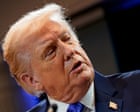
SP
BravenNow
Trump’s global tariffs have finally been overturned. What next? | Steven Greenhouse
| United Kingdom | business | ✓ Verified - theguardian.com

Trump’s global tariffs have finally been overturned. What next? | Steven Greenhouse

#Supreme Court #Donald Trump #Tariffs #Congress #International Emergency Economic Powers Act #John Roberts #Learning Resources Inc v Trump #Presidential Authority

📌 Key Takeaways

  • Supreme Court overturned Trump's global tariffs, affirming congressional authority over tariffs
  • Chief Justice Roberts emphasized that Trump misinterpreted the International Emergency Economic Powers Act
  • This marked the first major rebuke of Trump's policies during his second term
  • Trump responded by attacking the justices who ruled against him

📖 Full Retelling

The US Supreme Court ruled against President Donald Trump on Friday by overturning his global tariffs, establishing that Congress, not the executive branch, holds the constitutional authority to impose taxes and tariffs. The unanimous decision in Learning Resources Inc v Trump marked the first time during Trump's second term that the justices struck down one of his policies, specifically targeting his signature economic approach that had been used to impose tariffs against more than 80 countries. Chief Justice John Roberts, writing for the majority, emphasized that the International Emergency Economic Powers Act, which Trump had invoked to justify the tariffs, makes no mention of tariffs and that Congress would have explicitly granted such power if it had intended to do so. The ruling came after the court's conservative supermajority had frequently sided with Trump in numerous 'shadow docket' cases, raising questions about whether this decision signaled a shift in the court's approach to presidential overreach. In response, Trump vehemently attacked the justices who ruled against him, calling them 'fools and lapdogs' and suggesting they had been 'swayed by foreign interests,' while also claiming the decision posed an existential threat to national security.

🏷️ Themes

Presidential Power, Separation of Powers, Judicial Independence

📚 Related People & Topics
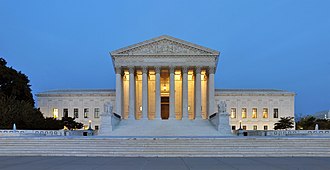
Supreme court

Supreme court

Highest court in a jurisdiction

In most legal jurisdictions, a supreme court, also known as a court of last resort, apex court, high (or final) court of appeal, and court of final appeal, is the highest court within the hierarchy of courts. Broadly speaking, the decisions of a supreme court are binding on all other courts in a nat...

View Profile → Wikipedia ↗
Congress

Congress

Formal meeting of representatives

A congress is a formal meeting of the representatives of different countries, constituent states, organizations, trade unions, political parties, or other groups. The term originated in Late Middle English to denote an encounter (meeting of adversaries) during battle, from the Latin congressus.

View Profile → Wikipedia ↗
International Emergency Economic Powers Act

International Emergency Economic Powers Act

United States federal law

The International Emergency Economic Powers Act (IEEPA), Title II of Pub. L. 95–223, 91 Stat. 1626, enacted December 28, 1977, is a United States federal law authorizing the president to regulate international commerce after declaring a national emergency in response to any unusual and extraordinary...

View Profile → Wikipedia ↗
Tariff

Tariff

Goods import or export tax

A tariff or import tax is a duty imposed by a national government, customs territory, or supranational union on imports of goods and is paid by the importer. Exceptionally, an export tax may be levied on exports of goods or raw materials and is paid by the exporter. Besides being a source of revenue...

View Profile → Wikipedia ↗
Donald Trump

Donald Trump

President of the United States (2017–2021; since 2025)

Donald John Trump (born June 14, 1946) is an American politician, media personality, and businessman who is the 47th president of the United States. A member of the Republican Party, he served as the 45th president from 2017 to 2021. Born into a wealthy New York City family, Trump graduated from the...

View Profile → Wikipedia ↗

Entity Intersection Graph

Connections for Supreme court:

👤 Donald Trump 19 shared
🌐 Tariff 14 shared
🌐 Tariffs in the Trump administration 12 shared
🌐 International Emergency Economic Powers Act 6 shared
🌐 Commercial policy 5 shared
View full profile

Deep Analysis

Why It Matters

The Supreme Court's decision to overturn Trump’s global tariffs marks the first time in his second term that a Trump policy has been struck down, signaling a potential shift in the Court’s willingness to check executive power. It also clarifies that tariff authority rests with Congress, not the president, reshaping U.S. trade policy.

Context & Background

  • Supreme Court ruled against Trump on tariffs, first time in second term
  • Tariffs were part of Trump’s signature economic policy affecting 80+ countries
  • Court held that Congress, not the president, has authority to impose tariffs

What Happens Next

The ruling may prompt the Court to consider other Trump‑related cases, such as the Federal Reserve appointment dispute, and could influence future trade policy decisions. It also sets a precedent that may deter the administration from using unilateral tariff powers in the future.

Frequently Asked Questions

What was the legal basis for the Court's decision?

The Court held that the International Emergency Powers Act does not grant the president the authority to impose tariffs, and that such power belongs to Congress.

How did Trump react to the ruling?

Trump criticized the justices, calling them fools and lapdogs, and threatened that the decision would threaten national security.

What could be the next major case involving the Supreme Court and Trump?

The Court may face a case over Trump’s attempt to remove Federal Reserve member Lisa Cook, which could test the Court’s stance on executive overreach.

What impact does this ruling have on U.S. trade policy?

It limits the president’s ability to unilaterally impose tariffs, potentially leading to more congressional involvement in trade decisions.

Original Source
Trump’s global tariffs have finally been overturned. What next? Steven Greenhouse The US supreme court ruled against the president. Let’s hope the court removes its pro-Trump glasses on other issues and stands up for the rule of law T here’s no denying that the US supreme court’s long-awaited ruling that overturned Donald Trump’s global tariffs is important, and if the ruling turns out to be a harbinger that the court is ready to abandon its startling sycophancy toward the US president, it could prove hugely important. The ruling this Friday is the first time during Trump’s second term that the justices have struck down one of his policies. Not only that, the policy they struck down is Trump’s signature economic policy – he has used tariffs to bash, lord over and terrorize dozens of other countries and make himself the King of the Economic Jungle. In the court’s main opinion, joined by three conservative justices and three liberals, chief justice John Roberts used some sharp language to slap down Trump’s tariffs, writing that the constitution specifically gives Congress, not the president, the power to impose taxes and tariffs. ( Roberts noted that tariffs are indeed taxes.) Roberts added that Trump had misinterpreted the law he invoked to impose tariffs against more than 80 countries, noting that the law – the International Emergency Emergency Powers Act – doesn’t mention the word tariffs even once as it lays out numerous ways presidents can regulate imports. Roberts added that if Congress had wanted to give presidents the power to impose tariffs under that law, it would have specifically said so. In the tariffs case, Learning Resources Inc v Trump, Roberts seemed appalled at the extraordinary powers Trump had seized to impose whatever tariffs he wanted at any amount he wanted against any country he wanted. Roberts wrote that “the President asserts the extraordinary power to unilaterally impose tariffs of unlimited amount, duration, and scope” and that under the ad...
Read full article at source

Source

theguardian.com

More from United Kingdom

News from Other Countries

🇺🇸 USA

🇺🇦 Ukraine