
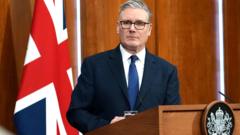
UK will seek closer ties with EU in light of Iran war, Starmer says
📖 Full Retelling
📚 Related People & Topics
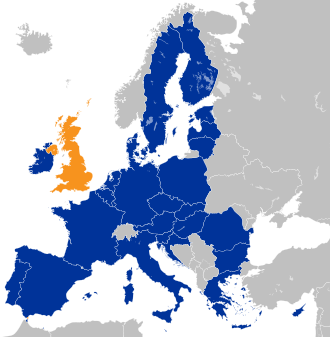
Brexit
Withdrawal of the UK from the EU
Brexit (; a portmanteau of "Britain" and "Exit") was the withdrawal of the United Kingdom (UK) from the European Union (EU). Brexit took place at 23:00 GMT on 31 January 2020 (00:00 1 February 2020 CET). The UK, which joined the EU precursor, the European Communities (EC), on 1 January 1973, is the ...

European Union
Supranational political and economic union
The European Union (EU) is a supranational political and economic union of 27 member states that are located primarily in Europe. The union has a total area of 4,233,255 km2 (1,634,469 sq mi) and an estimated population of more than 450 million as of 2025. The EU is often described as a sui generis ...
List of wars involving Iran
This is a list of wars involving the Islamic Republic of Iran and its predecessor states. It is an unfinished historical overview.

United Kingdom
Country in northwestern Europe
The United Kingdom of Great Britain and Northern Ireland, commonly known as the United Kingdom (UK) or Britain, is a country in northwestern Europe, off the coast of the continental mainland. It comprises England, Scotland, Wales and Northern Ireland, with a population of over 69 million in 2024. Th...

Keir Starmer
Prime Minister of the United Kingdom since 2024
# Sir Keir Starmer **Sir Keir Rodney Starmer** (born 2 September 1962) is a British politician and lawyer serving as Prime Minister of the United Kingdom since July 2024. A member of the Labour Party, he has served as Leader of the Labour Party since 2020 and has been the Member of Parliament (MP) ...
Entity Intersection Graph
Connections for Brexit:
Mentioned Entities
Deep Analysis
Why It Matters
This announcement signals a significant shift in UK foreign policy and post-Brexit relations with Europe, potentially affecting trade, security cooperation, and diplomatic alignment. It matters because closer EU ties could enhance collective security responses to Middle Eastern conflicts while impacting UK sovereignty and domestic politics. British businesses, citizens traveling to Europe, and defense officials would be directly affected by any policy changes resulting from this realignment.
Context & Background
- The UK formally left the European Union in January 2020 after the 2016 Brexit referendum
- UK-EU relations have been strained by disputes over Northern Ireland protocol and fishing rights since Brexit
- Iran has been involved in regional conflicts through proxy groups in Yemen, Syria, and Lebanon
- The UK previously participated in EU foreign policy coordination mechanisms before Brexit
- Labour Party under Keir Starmer won a decisive victory in July 2024 UK general elections
What Happens Next
Expect formal diplomatic overtures to EU institutions in coming weeks, potential emergency security consultations about Iran conflict, and possible negotiations on enhanced cooperation agreements. The UK may seek to rejoin certain EU foreign policy coordination mechanisms temporarily or permanently. Domestic political debates will intensify about the extent of EU realignment and its implications for UK sovereignty.
Frequently Asked Questions
Regional conflicts like the Iran war require coordinated international responses that are more effective through collective action. The UK recognizes that working closely with European partners enhances diplomatic leverage, intelligence sharing, and security coordination in volatile situations.
The UK likely wants enhanced intelligence sharing, coordinated sanctions, joint diplomatic initiatives, and possibly temporary participation in EU foreign policy decision-making forums. They may also seek streamlined security and defense cooperation mechanisms.
Starmer has consistently advocated for closer UK-EU relations since becoming Labour leader, though previously focused on economic ties. This represents an expansion of that approach into foreign policy and security domains, reflecting practical governance realities.
No, this appears focused on specific foreign policy and security cooperation rather than broader institutional reintegration. The political and constitutional barriers to EU membership remain substantial, and Starmer has ruled out rejoining in the near term.
Conservative critics will likely frame this as backtracking on Brexit sovereignty and compromising UK independence in foreign policy. They may argue for maintaining distance from EU structures while pursuing bilateral cooperation with individual European nations.