
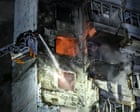
Ukraine war briefing: Moldova declares emergency after Russian attack cuts key power line
#Moldova #Ukraine war #Russian attack #power line #state of emergency #energy disruption #infrastructure damage
📌 Key Takeaways
- Moldova declared a state of emergency after a Russian attack severed a key power line from Ukraine
- The attack disrupted electricity supply to parts of Moldova, exacerbating energy security concerns
- The incident highlights the spillover effects of the Ukraine war on neighboring countries' infrastructure
- Moldova's reliance on Ukrainian energy imports makes it vulnerable to wartime disruptions
📖 Full Retelling
🏷️ Themes
Energy Security, War Spillover
📚 Related People & Topics

List of wars involving Ukraine
The following is a list of major conflicts fought by Ukraine, by Ukrainian people or by regular armies during periods when independent states existed on the modern territory of Ukraine, from the Kievan Rus' times to the present day. It also includes wars fought outside Ukraine by Ukrainian military....

Moldova
Country in Eastern Europe
Moldova, officially the Republic of Moldova, is a landlocked country in Eastern Europe, with an area of 33,843 km2 (13,067 sq mi) and a population of 2.38 million. Moldova is bordered by Romania to the west and Ukraine to the north, east, and south. The unrecognised breakaway state of Transnistria l...
Entity Intersection Graph
Connections for List of wars involving Ukraine:
Mentioned Entities
Deep Analysis
Why It Matters
This development matters because it represents a dangerous escalation of the Ukraine conflict's regional impact, directly threatening Moldova's energy security and sovereignty. It affects Moldova's 2.6 million citizens who now face potential blackouts and energy shortages during winter. The attack demonstrates how Russia's military actions can destabilize neighboring countries beyond Ukraine's borders, potentially drawing more European nations into the conflict's consequences. This also raises concerns about Russia's willingness to target civilian infrastructure that supports multiple countries.
Context & Background
- Moldova has maintained a neutral status but has faced Russian pressure due to its pro-European orientation and the frozen conflict in Transnistria where Russian troops are stationed
- Moldova has been heavily dependent on Russian energy, particularly electricity imports from the Moldavskaya GRES power plant in Transnistria
- The country has been working to diversify energy sources since Russia's full-scale invasion of Ukraine in 2022, but remains vulnerable to energy disruptions
- Moldova declared a state of emergency in October 2022 due to previous energy crises caused by the war
- Transnistria, a breakaway region of Moldova, hosts approximately 1,500 Russian peacekeeping troops and has been a source of tension for decades
What Happens Next
Moldova will likely seek emergency energy assistance from EU partners like Romania while accelerating alternative energy projects. The EU may provide additional financial and technical support to help Moldova secure its energy grid. Russia may use Moldova's vulnerability as leverage in negotiations or to discourage further Western alignment. International organizations like the UN or OSCE might investigate the attack on critical infrastructure.
Frequently Asked Questions
Russia may be punishing Moldova for its pro-Western stance and support for Ukraine, while demonstrating how vulnerable neighboring countries remain to Russian pressure. This also serves as a warning to other former Soviet states considering closer ties with NATO or the EU.
Citizens face potential rolling blackouts, heating shortages during winter, and economic disruption as businesses struggle with unreliable power. This emergency declaration allows the government to implement rationing measures and seek international assistance more rapidly.
Moldova has maintained diplomatic relations but has increasingly aligned with the EU since Russia's invasion of Ukraine. Tensions exist due to Russia's support for Transnistria's separatist government and historical energy dependence that gives Moscow leverage.
While unlikely to trigger direct Moldovan military involvement, this attack increases regional instability and could lead to greater NATO/EU security guarantees for Moldova. The country has emphasized its constitutional neutrality but may request additional defensive support.
The European Union will probably provide emergency energy supplies and financial assistance while accelerating Moldova's integration into European energy networks. This incident strengthens the case for Moldova's EU membership application and may prompt additional sanctions discussion against Russia.