
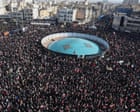
US and Israel launch strikes across Iran as crowds celebrate new supreme leader
#US #Israel #Iran #military strikes #supreme leader #celebrations #tensions
📌 Key Takeaways
- US and Israel conducted coordinated military strikes across Iran.
- The strikes occurred during public celebrations for Iran's new supreme leader.
- The operation signals heightened tensions between Iran and Western allies.
- The timing suggests a strategic move to disrupt Iranian leadership transition.
📖 Full Retelling
🏷️ Themes
Military Conflict, Geopolitical Tensions
📚 Related People & Topics

Iran
Country in West Asia
# Iran **Iran**, officially the **Islamic Republic of Iran** and historically known as **Persia**, is a sovereign country situated in West Asia. It is a major regional power, ranking as the 17th-largest country in the world by both land area and population. Combining a rich historical legacy with a...

United States
Country primarily in North America
The United States of America (USA), also known as the United States (U.S.) or America, is a country primarily located in North America. It is a federal republic of 50 states and a federal capital district, Washington, D.C. The 48 contiguous states border Canada to the north and Mexico to the south, ...

Israel
Country in West Asia
Israel, officially the State of Israel, is a country in the Southern Levant region of West Asia. It is bordered by Lebanon to the north, Syria to the northeast, Jordan to the east, and Egypt to the southwest. Israel occupies the West Bank and the Gaza Strip of the Palestinian territories, as well as...
Entity Intersection Graph
Connections for Iran:
Mentioned Entities
Deep Analysis
Why It Matters
This news is critically important because it represents a major escalation in Middle Eastern tensions, potentially triggering a broader regional conflict. It directly affects Iranian civilians and military personnel, Israeli and American forces, and could destabilize global oil markets and international security. The timing during a leadership transition makes Iran particularly vulnerable to internal and external pressures.
Context & Background
- Iran has been under US sanctions since the 1979 Islamic Revolution, with tensions escalating in recent years over Iran's nuclear program
- Israel and Iran have engaged in a long-running shadow war, with Israel frequently striking Iranian targets in Syria and Iran supporting anti-Israeli militant groups
- Iran recently underwent a leadership transition following the death of Supreme Leader Ali Khamenei, creating political uncertainty
- The US and Israel have previously conducted joint military exercises demonstrating coordination against Iranian threats
- Iran's nuclear facilities have been targets of previous cyberattacks and sabotage operations attributed to Israel and the US
What Happens Next
Iran will likely convene an emergency security council meeting and may retaliate against US or Israeli assets in the region, potentially through proxy forces in Iraq, Syria, or Lebanon. The UN Security Council will likely hold emergency sessions within 48 hours. Oil prices are expected to spike significantly as markets react to potential supply disruptions. Regional allies including Saudi Arabia and UAE will increase security measures.
Frequently Asked Questions
Military strategists often target adversaries during leadership transitions when command structures may be less coordinated. This timing could exploit temporary vulnerabilities in Iran's decision-making processes during the transfer of power to a new supreme leader.
Based on previous patterns, strikes likely targeted Iranian nuclear facilities, Revolutionary Guard bases, missile storage sites, or drone manufacturing centers. The 'across Iran' description suggests multiple locations rather than a single target.
These strikes will almost certainly collapse any ongoing nuclear negotiations and harden Iran's position. Iran will likely accelerate its nuclear program in response, viewing diplomacy as ineffective against military action.
Iran may direct Hezbollah in Lebanon, Houthi rebels in Yemen, or Shiite militias in Iraq to attack US or Israeli interests. This allows for retaliation while maintaining some plausible deniability and avoiding direct state-to-state conflict escalation.
Russia and China will likely condemn the strikes at the UN while avoiding direct military involvement. European allies will express concern about escalation but may privately support actions limiting Iran's nuclear capabilities. Gulf Arab states will publicly call for de-escalation while privately welcoming pressure on Iran.