
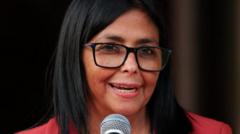
US lifts sanctions on Venezuelan interim leader Delcy Rodríguez
📖 Full Retelling
📚 Related People & Topics

Venezuela
Venezuela, officially the Bolivarian Republic of Venezuela, is a country on the northern coast of South America, consisting of a continental landmass and various islands and islets in the Caribbean Sea. It comprises an area of 912,050 km2 (352,140 sq mi), with a population estimated at 31.8 million ...

United States
Country primarily in North America
The United States of America (USA), also known as the United States (U.S.) or America, is a country primarily located in North America. It is a federal republic of 50 states and a federal capital district, Washington, D.C. The 48 contiguous states border Canada to the north and Mexico to the south, ...
Entity Intersection Graph
Connections for Venezuela:
Mentioned Entities
Deep Analysis
Why It Matters
This decision matters because it signals a significant shift in U.S. policy toward Venezuela's government, potentially easing diplomatic tensions and opening doors for renewed negotiations. It directly affects Venezuelan political leaders who may see reduced international isolation, while also impacting U.S. businesses that could explore renewed economic ties. The move could influence regional stability in Latin America and alter the dynamics of Venezuela's ongoing political crisis.
Context & Background
- The U.S. imposed sanctions on Delcy Rodríguez in 2019 as part of broader measures against Nicolás Maduro's government following disputed elections
- Rodríguez serves as Venezuela's Executive Vice President and has been a key figure in Maduro's administration since 2018
- U.S.-Venezuela relations have been strained since 2015, with Washington recognizing opposition leader Juan Guaidó as interim president in 2019
- Previous sanctions targeted Venezuelan oil, gold, and government officials to pressure Maduro to hold free elections
What Happens Next
Observers will watch for whether this sanction relief leads to broader diplomatic talks between the U.S. and Venezuelan governments. Venezuela may seek additional sanctions relief on other officials and economic sectors. The opposition may react to this policy shift, potentially affecting unity among anti-Maduro factions. Further developments could emerge around potential prisoner exchanges or electoral roadmap negotiations.
Frequently Asked Questions
The U.S. likely lifted sanctions as a diplomatic gesture to encourage negotiations with Venezuela's government. Rodríguez's position as Executive Vice President makes her a key channel for communication. This targeted relief may test Venezuela's willingness to engage in broader talks about democratic reforms.
While directly impacting government officials, this move could indirectly affect citizens if it leads to broader economic sanction relief. Reduced tensions might create conditions for addressing humanitarian crises. However, immediate effects on daily life may be limited without more comprehensive policy changes.
Not necessarily—sanction relief on individual officials doesn't equate to formal recognition. The U.S. maintains its position calling for free elections. This appears to be a tactical adjustment rather than a fundamental policy shift regarding Venezuela's leadership legitimacy.
Rodríguez was sanctioned for allegedly undermining democratic processes and human rights in Venezuela. Specific accusations included involvement in preventing free elections and suppressing political opposition. The sanctions froze her U.S. assets and prohibited Americans from dealing with her.
It creates an opening for increased dialogue, particularly on issues like migration, energy, and humanitarian aid. However, significant cooperation would require addressing core disagreements about democratic governance. Both sides will likely proceed cautiously while assessing each other's next moves.