
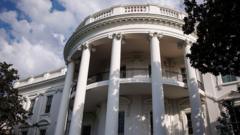
US Secret Service investigates reports of gunfire near White House
📖 Full Retelling
📚 Related People & Topics

White House
Residence and workplace of the US president
# The White House The **White House** is the official residence and principal workplace of the president of the United States. Located at **1600 Pennsylvania Avenue NW** in Washington, D.C., it stands as one of the most recognizable symbols of the American presidency and the United States governmen...

Washington, D.C.
Federal capital district of the United States
Washington, D.C., officially the District of Columbia and commonly known as simply Washington or D.C., is the capital city and federal district of the United States. The city is on the Potomac River across from Virginia and shares land borders with Maryland to its north and east. It was named after ...
Entity Intersection Graph
Connections for Secret Service:
Mentioned Entities
Deep Analysis
Why It Matters
This incident matters because it involves potential security threats at one of the most heavily protected locations in the world, raising immediate concerns about presidential safety and national security protocols. It affects the Secret Service's operational procedures, White House staff and residents, nearby businesses and residents in Washington D.C., and could influence public confidence in government security measures. Such events often trigger reviews of security protocols and may lead to changes in protective operations around sensitive government facilities.
Context & Background
- The White House has been the target of multiple security incidents throughout history, including the 2011 shooting where a man fired at the building hitting windows
- In 2020, protesters breached temporary fencing around Lafayette Square near the White House during civil unrest
- The Secret Service has significantly enhanced White House security measures since the 9/11 attacks, including expanding the security perimeter and implementing advanced surveillance systems
- Previous incidents have led to security reviews and protocol changes, such as after the 2014 fence-jumping incident where a man scaled the fence and entered the White House
- The area around the White House has multiple layers of security including vehicle barriers, armed guards, and sophisticated monitoring technology
What Happens Next
The Secret Service will continue their investigation to determine if gunfire actually occurred, identify any potential suspects, and review security camera footage from the area. Within days, they will likely issue a preliminary report on their findings and may implement temporary enhanced security measures. Congressional oversight committees may request briefings on the incident, and depending on the investigation's outcome, there could be longer-term security protocol reviews in the coming weeks.
Frequently Asked Questions
While serious security breaches are rare, the White House experiences regular security incidents including fence-jumping attempts, suspicious packages, and occasional reports of gunfire. Most turn out to be false alarms or minor incidents, but each triggers a full security response.
The Secret Service immediately implements lockdown procedures for the White House, secures the perimeter, deploys emergency response teams, and begins investigating the source of the report. They coordinate with local law enforcement and may temporarily restrict access to surrounding areas.
During such incidents, the White House typically goes into lockdown mode, restricting movement within the complex and potentially delaying scheduled events or meetings. Normal operations resume once the Secret Service determines the area is secure.
The White House is protected by multiple layers of security including reinforced fences, vehicle barriers, armed Secret Service agents, sophisticated surveillance systems, anti-drone technology, and coordinated response plans with multiple law enforcement agencies.
Depending on the investigation findings, this incident could prompt security reviews that might lead to permanent changes such as enhanced surveillance, modified security perimeters, or updated response protocols, particularly if it reveals vulnerabilities in current systems.