
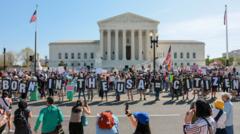
US Supreme Court appears sceptical of US birthright citizenship challenge
📖 Full Retelling
Trump attended the oral arguments in person on Wednesday, a rare move by a sitting president that underscored the high stakes of the case.
📚 Related People & Topics
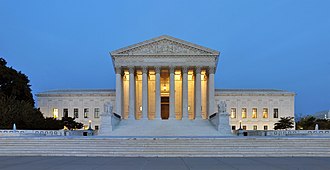
Supreme court
Highest court in a jurisdiction
In most legal jurisdictions, a supreme court, also known as a court of last resort, apex court, high (or final) court of appeal, and court of final appeal, is the highest court within the hierarchy of courts. Broadly speaking, the decisions of a supreme court are binding on all other courts in a nat...
Entity Intersection Graph
Connections for Supreme court:
🌐
Tariffs in the Trump administration
25 shared
👤
Donald Trump
19 shared
🌐
Tariff
16 shared
🌐
Commercial policy
12 shared
Mentioned Entities
Original Source
US Supreme Court appears sceptical of US birthright citizenship challenge 5 hours ago Share Save Add as preferred on Google Daniel Bush Washington correspondent The Supreme Court has appeared sceptical of President Donald Trump's executive order limiting birthright citizenship, a sign the justices could strike down a key element of his immigration agenda. A majority of the court seemed unconvinced the US should stop granting citizenship to children of undocumented immigrants and some temporary US visitors. The administration has argued that limiting birthright citizenship is necessary to rein in illegal immigration. Opponents argue it would upend more than a century of precedent and unravel a cornerstone of US immigration law. Trump attended the oral arguments on Wednesday, a rare move by a sitting president that underscored the case's high stakes. A defeat for the Republican president would mark a second straight setback at the high court, following the decision last month that invalidated his global tariffs. A win would help Trump deliver on his pledge to reshape America's immigration policies. During more than two hours of arguments, US Solicitor General John Sauer sought to convince the justices that the 14th Amendment - which establishes birthright citizenship and was extended to formerly enslaved people - and subsequent court rulings and laws passed by Congress all mistakenly expanded birthright citizenship. Chief Justice John Roberts, a key swing vote on the court, questioned Trump's authority to exclude children of undocumented immigrants from receiving US citizenship. "I'm not quite sure how you can get to that big group," Roberts said. Trump wants to end birthright citizenship. Where do other countries stand? The oral arguments turned on a key clause in the 14th Amendment, which grants citizenship to all people born or naturalised in the US who are "subject to the jurisdiction thereof". Sauer argued that the clause should only apply to the children of fore...
Read full article at source