
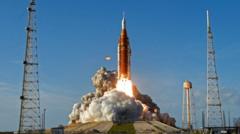
Watch: Artemis II's journey so far as it leaves Earth orbit... in 85 seconds
📖 Full Retelling
📚 Related People & Topics

NASA
American space and aeronautics agency
The National Aeronautics and Space Administration (NASA ) is an independent agency of the U.S. federal government responsible for the United States' civil space program and for research in aeronautics and space exploration. Headquartered in Washington, D.C., NASA operates ten field centers across th...

Artemis II
Artemis program's second lunar flight
Artemis II is a planned lunar spaceflight mission under the Artemis program, led by NASA. It is intended to be the second flight of the Space Launch System (SLS), and the first crewed mission of the Orion spacecraft. It is the first crewed mission around the Moon, and beyond low Earth orbit, since A...
Entity Intersection Graph
Connections for NASA:
Mentioned Entities
Deep Analysis
Why It Matters
The Artemis II mission represents humanity's return to crewed lunar exploration after more than 50 years, advancing international space collaboration and inspiring STEM education globally. This mission directly affects NASA's international partners, aerospace contractors, and scientific communities while demonstrating new technologies for future Mars missions. The successful departure from Earth orbit validates critical systems needed to sustain astronauts during deep space travel, making this a pivotal step toward establishing sustainable lunar presence.
Context & Background
- Artemis II is the first crewed mission in NASA's Artemis program, following the uncrewed Artemis I test flight that orbited the Moon in 2022
- The last human lunar mission was Apollo 17 in 1972, marking a 50+ year gap in crewed lunar exploration
- Artemis II will carry four astronauts - including the first woman and first person of color to travel to lunar distance - but will not land on the Moon
- The mission utilizes NASA's Space Launch System (SLS) rocket and Orion spacecraft, developed through international collaboration with ESA, CSA, and JAXA
- Artemis program aims to establish sustainable lunar exploration by 2028 as a stepping stone for eventual Mars missions
What Happens Next
Artemis II will complete its multi-day journey around the Moon before returning to Earth, with splashdown expected in late 2025. Following this mission, Artemis III will attempt the first crewed lunar landing since Apollo, currently scheduled for 2026. NASA will analyze mission data to certify systems for longer Artemis III mission, while continuing development of lunar Gateway station and lunar lander systems with commercial partners.
Frequently Asked Questions
Artemis II uses modern technology including advanced computers, life support systems, and international spacecraft components unlike Apollo's entirely US-built systems. The mission also tests new orbital trajectories and communication systems needed for future lunar Gateway station operations.
This mission serves as a crucial systems test and crew certification flight before attempting lunar landing with Artemis III. The crew will validate Orion's performance, life support, and emergency procedures in deep space environment while testing new navigation and communication systems.
The mission is scheduled for approximately 10 days total duration. The crew will spend several days traveling to lunar distance, complete a lunar flyby, then begin the return journey to Earth, testing systems throughout all mission phases.
Primary risks include radiation exposure beyond Earth's magnetic field, spacecraft system failures in deep space where rescue is impossible, and re-entry challenges at higher speeds than low Earth orbit returns. NASA has implemented multiple redundancies and extensive testing to mitigate these risks.
The mission tests deep space habitation systems, radiation protection, and navigation techniques essential for future Mars missions. Data collected will inform life support requirements and crew health protocols for multi-year interplanetary voyages.