Documentary captures Tzotzil women's traditional rituals in Chiapas
Film showcases traditional crafts like sheep shearing and natural dyeing
Addresses ongoing discrimination and gender inequality in the community
Director uses filmmaking to bridge personal gap in understanding indigenous cultures
Blurs line between ethnographic documentary and artistic expression
📖 Full Retelling
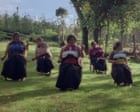
Mexican filmmaker Gabriela Domínguez Ruvalcaba's documentary 'Ways to Traverse a Territory' documents the traditional daily rituals of Tzotzil indigenous women in the mossy hills of Chiapas, Mexico, capturing their deep connection with nature and preserving an ancient way of life facing modern challenges. The film presents a poetic meditation on how these women maintain their pastoral traditions despite the march of time, focusing on their practices of hand-shearing sheep, spinning yarns with traditional tools, and using natural dyes for fabrics that transform everyday tasks into artistic expressions. Ruvalcaba's cinematography emphasizes the women's relationship with their environment, often framing them against the majestic landscapes of Chiapas to highlight how the community treats natural resources with care and respect, though the documentary doesn't shy away from acknowledging ongoing discrimination and gender inequality within the community itself. The director, who grew up in the area but wasn't taught about indigenous communities, uses filmmaking as a conduit to bridge this gap, creating an artistic exploration that occasionally blurs the line between ethnographic documentation and aesthetic expression, particularly in a fascinating moment when the Tzotzil women comment on the camera setup, acknowledging how filmmaking, like their weaving traditions, can be an artisanal art form.
🏷️ Themes
Cultural preservation, Indigenous rights, Gender inequality
The Tzotzil are an Indigenous Maya people of the central highlands of Chiapas, Mexico. As of 2000, they numbered about 298,000. The municipalities with the largest Tzotzil population are Chamula (48,500), San Cristóbal de las Casas (30,700), and Zinacantán (24,300), in the Mexican state of Chiapas.
Chiapas, officially the Free and Sovereign State of Chiapas, is one of the states that make up the 32 federal entities of Mexico. It comprises 124 municipalities as of September 2017 and its capital and largest city is Tuxtla Gutiérrez. Other important population centers in Chiapas include Ocosingo,...
A documentary film (often described simply as a documentary) is a nonfiction, motion picture intended to "document reality, primarily for instruction, education or maintaining a historical record". The American author and media analyst Bill Nichols has characterized the documentary in terms of "a fi...
Physical artifact or intangible attribute of a society inherited from past generations
Cultural heritage is the tangible and intangible legacy of a group or society that is inherited from past generations. Not all legacies of past generations are "heritage"; rather, heritage is a product of selection by society.
Cultural heritage includes tangible culture (such as buildings, monuments...
Review Ways to Traverse a Territory review – documenting an ancient and disappearing way of life Gabriela Domínguez Ruvalcaba’s meditative documentary follows the traditional daily rituals of Mexico’s Tzotzil women and their deep connection with nature A poetic calm subsumes Gabriela Domínguez Ruvalcaba’s languid documentary, shot among the mossy hills of Chiapas in Mexico. Here dwells the indigenous Tzotzil community which has kept a pastoral way of life against the march of time. Apart from the odd forest ranger and passerby, Ruvalcaba’s film focuses almost entirely on the Tzotzil women. Together, they tend herds of sheep which they still shear by hand, and use traditional tools for spinning yarns and natural dye for fabrics. Stunning to behold, these traditional practices not only keep cultural heritage alive but also introduce an element of artistry into every day rituals. The women are often pictured in wide shots that take in the majestic landscape that surrounds them, furthering the deep relationship between the Tsotsil community and their environment in which natural resources are treated with care and respect. At the same time, Chiapas is far from an idyll. One woman says that, although they are now treated by nonindigenous people with more respect, discrimination still exists. Another speaks of gender inequality within her community and how her father prevented her from accessing education. Ruvalcaba’s film also represents different kinds of crossings. The region, for instance, is lined with historic trails, while the camera lens also doubles as a threshold. The director grew up in the area but was not taught about the Indigenous communities; film-making becomes a conduit to bridge this gap. Though the stylised framing can at times err on the side of aestheticisation, there’s a fascinating moment where the ethnographic gaze is flipped. As they are being filmed, the Tsotsil women suddenly comment on Ruvalcaba’s camera setup and acknowledge the technical spe...