
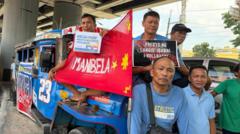
'We are being choked': Philippines transport workers strike over fuel costs
📖 Full Retelling
📚 Related People & Topics

Philippines
Archipelagic country in Southeast Asia
The Philippines, officially the Republic of the Philippines, is an archipelagic country in Southeast Asia. Located in the western Pacific Ocean, it consists of about 7,641 islands, with a total area of about 300,000 square kilometers, which are broadly categorized in three main geographical division...
Entity Intersection Graph
Connections for Philippines:
Mentioned Entities
Deep Analysis
Why It Matters
This strike is important because it directly impacts the daily lives of millions of Filipinos who rely on public transportation, potentially causing widespread disruptions to commutes, work, and the economy. It highlights the severe financial strain on transport workers, who are essential yet vulnerable to global fuel price fluctuations. The situation affects not only the workers and commuters but also businesses dependent on logistics, underscoring broader economic pressures in the Philippines.
Context & Background
- The Philippines has historically faced high fuel prices due to its reliance on imported oil, making it sensitive to global market changes.
- Transport workers, including jeepney drivers, have organized strikes in the past to protest fare hikes, fuel subsidies, and modernization programs.
- The government has previously implemented temporary fuel subsidies and fare adjustments in response to similar crises to mitigate public unrest.
What Happens Next
The government may negotiate with transport groups to offer short-term relief, such as fuel subsidies or fare increases, within the next week. If unresolved, the strike could escalate, leading to prolonged transport disruptions and potential protests. Long-term, this may accelerate discussions on transitioning to more sustainable and affordable public transport options.
Frequently Asked Questions
Transport workers are striking primarily due to soaring fuel costs, which are squeezing their incomes and making it difficult to operate vehicles profitably. They are demanding government intervention, such as subsidies or fare adjustments, to alleviate the financial burden.
The strike disrupts public transportation services, leading to longer wait times, overcrowded alternatives, and potential delays for millions of commuters. This can impact work, school, and daily activities, especially in urban areas reliant on jeepneys and buses.
In the past, the government has provided temporary fuel subsidies, approved fare hikes, or offered loan assistance to transport workers. These measures aim to ease immediate hardships but often face criticism for being insufficient or slow to implement.
Fuel prices are influenced by global factors like oil production and geopolitical events, making short-term decreases uncertain. The Philippine government has limited control over these prices, relying on imports and tax policies to manage costs.