
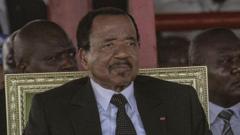
World's oldest leader to get a deputy for first time in 43-year rule
#Paul Biya #Cameroon #deputy appointment #succession planning #political stability #world's oldest leader #43-year rule
📌 Key Takeaways
- Cameroon's President Paul Biya, the world's oldest leader, has appointed a deputy for the first time in his 43-year rule.
- The move is seen as a potential step toward succession planning amid concerns about his advanced age and health.
- The appointment of a deputy may signal an effort to ensure political stability and continuity in the government.
- This development marks a significant shift in Biya's long-standing, centralized leadership style.
🏷️ Themes
Political succession, Leadership change
📚 Related People & Topics

Cameroon
Country in Central Africa
Cameroon, officially the Republic of Cameroon, is a country in Central Africa. It shares boundaries with Nigeria to the west and north, Chad to the northeast, the Central African Republic to the east, and Equatorial Guinea, Gabon, and the Republic of the Congo to the south. Its coastline lies on the...

Paul Biya
President and dictator of Cameroon since 1982
Paul Barthélemy Biya (né Biya'a bi Mvondo, born 13 February 1933) is a Cameroonian politician who has been serving as the second president of Cameroon since 1982. He was previously the fifth prime minister under President Ahmadou Ahidjo from 1975 to 1982. Widely considered to be a dictator, Biya is ...
Entity Intersection Graph
Connections for Cameroon:
Mentioned Entities
Deep Analysis
Why It Matters
This development is significant because it signals a potential transition in leadership for a country that has been under one ruler's control for over four decades. It affects the nation's political stability, international relations, and could indicate preparations for eventual succession. The appointment of a deputy may reassure citizens and foreign investors about continuity while also creating new power dynamics within the government.
Context & Background
- The leader has maintained uninterrupted rule for 43 years without previously appointing a formal deputy
- Many long-serving leaders eventually face succession challenges as they age
- Countries with extended single-leader rule often experience political uncertainty during leadership transitions
- The leader's advanced age has likely prompted discussions about governance continuity
What Happens Next
The deputy will likely assume increasing responsibilities over time, particularly in day-to-day governance. Observers will watch for signs of whether this represents genuine power-sharing or merely symbolic preparation. International partners may seek meetings with the new deputy to assess future diplomatic relations.
Frequently Asked Questions
Many authoritarian leaders avoid appointing deputies to prevent challenges to their authority. Maintaining sole control helps consolidate power and avoid creating potential rivals within the government structure.
Initially, the deputy may handle administrative duties and represent the leader at certain functions. Real decision-making authority will depend on how much power the leader chooses to delegate over time.
While appointing a deputy suggests preparation for transition, peaceful succession isn't guaranteed. Much depends on whether other power centers accept the deputy and whether the leader genuinely intends to transfer authority.
Reactions will vary - some may welcome it as a step toward stability, while others may view it skeptically as mere window dressing. Younger generations who've known only one leader may be particularly attentive to this development.