
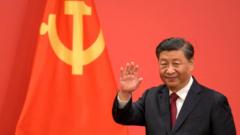
Xi's anti-corruption drive began 14 years ago. Why are the purges still going?
#Xi Jinping #anti-corruption drive #purges #political campaign #corruption #China #power consolidation #discipline enforcement
📌 Key Takeaways
- Xi Jinping's anti-corruption campaign has been ongoing for 14 years, indicating its sustained intensity.
- The persistence of purges suggests deep-rooted or evolving corruption challenges within the system.
- The campaign reflects a long-term political strategy to consolidate power and enforce discipline.
- Questions arise about the effectiveness and future direction of these continuous efforts.
📖 Full Retelling
🏷️ Themes
Anti-corruption, Political purges
📚 Related People & Topics

China
Country in East Asia
China, officially the People's Republic of China (PRC), is a country in East Asia. It is the second-most populous country after India, with a population exceeding 1.4 billion, representing 17% of the world's population. China borders fourteen countries by land across an area of 9.6 million square ki...

Xi Jinping
Leader of China since 2012
Xi Jinping (born 15 June 1953) is a Chinese statesman and politician who has served as the general secretary of the Chinese Communist Party (CCP) and chairman of the Central Military Commission (CMC) since 2012, and the president of China since 2013. Xi has been the leader of the fifth generation of...
Entity Intersection Graph
Connections for China:
Mentioned Entities
Deep Analysis
Why It Matters
This ongoing anti-corruption campaign matters because it represents one of the longest and most extensive political purges in modern Chinese history, affecting millions of officials and reshaping the Communist Party's internal dynamics. It impacts China's political stability, economic governance, and international perceptions of Xi Jinping's leadership. The campaign's continuation signals that corruption remains a systemic challenge despite years of enforcement, affecting ordinary citizens through both reduced corruption and potential political repression. This matters to investors, foreign governments, and Chinese citizens who must navigate an increasingly centralized political system.
Context & Background
- Xi Jinping launched the anti-corruption campaign shortly after becoming General Secretary in 2012, making 'tigers and flies' (high and low-ranking officials) a central theme of his administration.
- The campaign has disciplined over 4.7 million officials according to official statistics, including more than 400 at the ministerial level or above.
- Historically, anti-corruption drives in China have served both practical governance purposes and political consolidation, dating back to imperial times through Mao's campaigns to Hu Jintao's more limited efforts.
- The campaign has expanded beyond traditional corruption to include 'political discipline' violations, making it a tool for enforcing ideological conformity within the Party.
- China's anti-corruption efforts have included international dimensions through 'Operation Fox Hunt' to repatriate fugitives and recover assets overseas.
What Happens Next
The campaign will likely continue through at least 2027 when Xi's third term ends, potentially expanding to new sectors like finance and technology. Expect more high-profile cases ahead of the 20th Party Congress's third plenum in late 2024. International observers will monitor whether anti-corruption efforts intensify during economic challenges or ahead of leadership transitions. The campaign may increasingly target 'hidden corruption' in business dealings and family networks of officials.
Frequently Asked Questions
The campaign continues because corruption remains deeply embedded in China's political system, and Xi Jinping views it as essential for maintaining Party control. It has also evolved into a tool for political consolidation and removing potential rivals, making it strategically valuable for leadership stability.
The campaign has affected officials at all levels, from provincial governors and military leaders to local bureaucrats. It has particularly targeted officials in powerful state-owned enterprises, security apparatus, and regional governments where corruption networks were most entrenched.
Official reports claim significant success in reducing overt bribery and extravagant spending, but many analysts believe corruption has simply become more sophisticated and hidden. The campaign has certainly increased political risks for corrupt behavior but hasn't eliminated systemic incentives for corruption.
The campaign has complicated foreign business dealings as companies navigate uncertain political risks, while also enabling international cooperation on fugitive repatriation. Some Western governments view it skeptically as political purging rather than genuine reform, affecting diplomatic trust.
Initially, the campaign slowed economic activity as officials became risk-averse, but it may have improved efficiency by reducing corruption costs. Currently, it creates uncertainty for businesses dealing with state entities and affects investment decisions in sectors under scrutiny.