
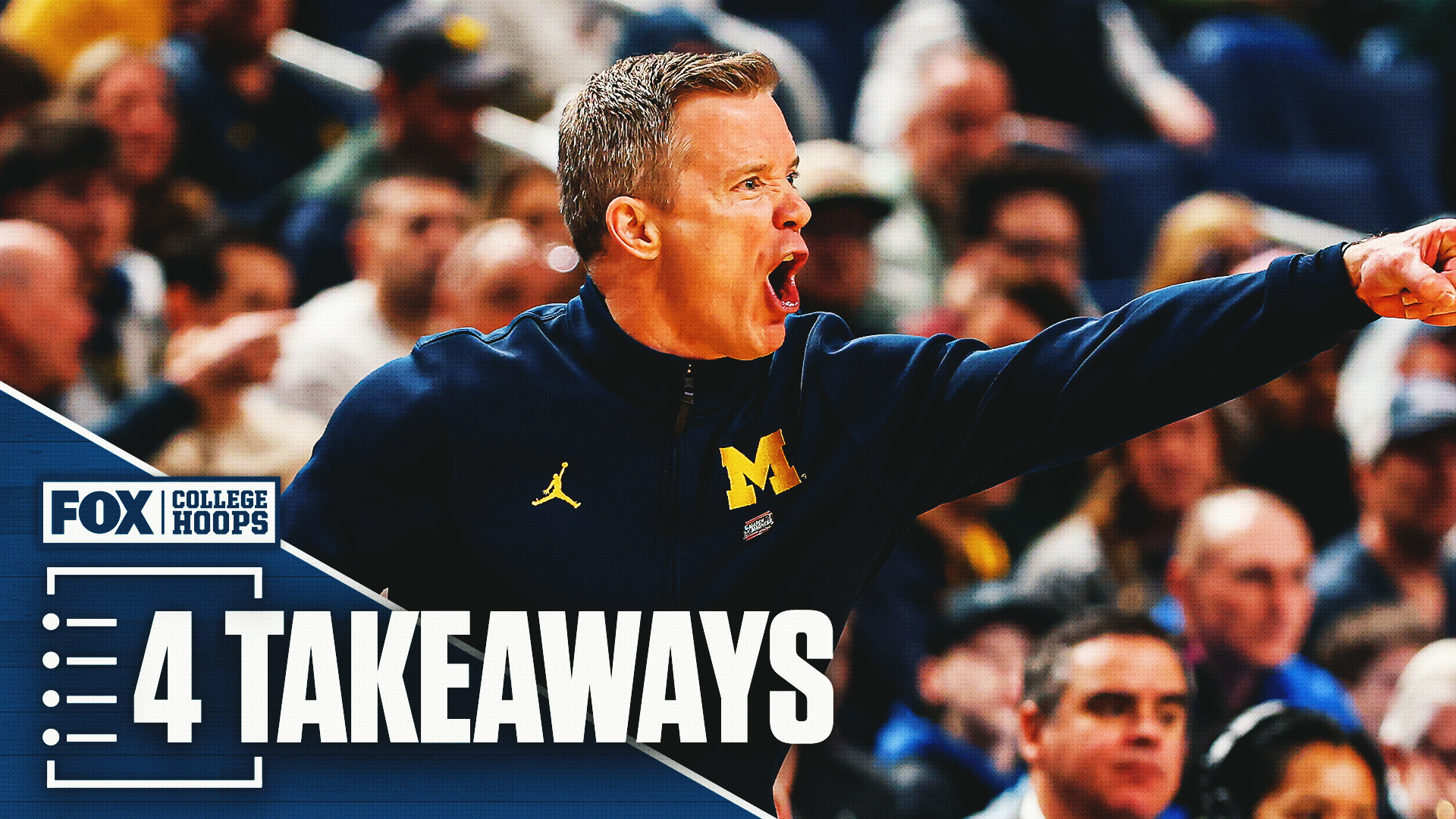
4 Takeaways From the NCAA Men's Basketball Tournament Sweet 16
#NCAA Tournament #Sweet 16 #Elite Eight #Big Ten #Power-conference #Basketball #March Madness #Seedings
📌 Key Takeaways
- Big Ten dominance with four teams advancing to Elite Eight
- Power-conference programs control the tournament landscape
- Three 1-seeds and No. 2 UConn remain strong title contenders
- The tournament reflects the overall strength and balance of major conferences
📖 Full Retelling
🏷️ Themes
Conference dominance, Tournament progression, Power structure, Historical significance
📚 Related People & Topics
NCAA tournament
Topics referred to by the same term
NCAA tournament may refer to a number of tournaments organized by the National Collegiate Athletic Association:

NCAA Division I men's basketball tournament
American collegiate men's basketball tournament
# NCAA Division I Men’s Basketball Tournament The **NCAA Division I Men’s Basketball Tournament**, widely known by the monikers **March Madness** and **The Big Dance**, is a premier single-elimination tournament held annually in the United States. The competition determines the national champion of...

Big Ten Conference
American collegiate athletics conference
The Big Ten Conference (formerly the Western Conference and the Big Nine Conference, among others) is a U.S. collegiate athletic conference. Founded as the Intercollegiate Conference of Faculty Representatives in 1896, it predates the founding of its regulating organization, the NCAA; it is the olde...

Basketball
Team sport
Basketball is a team sport in which two teams of five players each (excluding subs), opposing one another on a rectangular court, compete with the primary objective of shooting a basketball (approximately 9.4 inches (24 cm) in diameter) through the defender's hoop (a basket 18 inches (46 cm) in diam...
Entity Intersection Graph
Connections for NCAA tournament:
Mentioned Entities
Deep Analysis
Why It Matters
This news is significant as it highlights the unprecedented dominance of the Big Ten conference in this year's NCAA tournament, reshaping the narrative of college basketball power dynamics. It affects fans, players, coaches, and athletic departments as the tournament approaches its most critical stage. The performance has major implications for future recruiting, conference realignment discussions, and the perception of which conferences currently hold the most competitive advantage in college basketball.
Context & Background
- The NCAA Men's Basketball Tournament is a single-elimination championship event featuring 68 teams from various conferences
- The Sweet 16 refers to the round of 16 teams remaining in the tournament
- The Elite Eight is the subsequent round where the final eight teams compete for a spot in the Final Four
- The Big Ten has historically been one of the strongest basketball conferences but has never before sent six teams to the Sweet 16
- UConn has been a dominant force recently, winning national titles in 2014 and 2021
- Conference realignment has been a major trend in college athletics, with major conferences expanding their footprints
What Happens Next
The tournament will proceed to the Elite Eight round, followed by the Final Four (semifinals and championship game). The remaining teams will compete for the national championship title. UConn, as a No. 2 seed, has a strong opportunity to win its third national title in four years. The Big Ten's historic representation in the Elite Eight suggests the conference has a strong chance of winning this year's championship.
Frequently Asked Questions
This is a historic achievement for the conference, demonstrating unprecedented depth and competitiveness. It marks the first time any conference has sent six teams to the Sweet 16, highlighting the Big Ten's current dominance in college basketball.
UConn has established itself as a modern powerhouse with three national titles in the last four years. This level of sustained success places them among the elite programs in college basketball history.
According to Michigan coach Dusty May, financial parity and the addition of West Coast schools have enhanced the Big Ten's competitive environments and brand strength, making it the premier basketball conference.
This year's tournament features a historic level of Big Ten dominance, with the conference sending six teams to the Sweet 16 and four to the Elite Eight, while also maintaining representation from multiple major conferences.
While power-conference teams dominated, the presence of mid-major teams like No. 9 Iowa and No. 6 Tennessee shows that tournament upsets and parity remain part of March Madness, even as traditional powers continue to succeed.
Source Scoring
Detailed Metrics
Key Claims Verified
This is a definitional truth of the NCAA Men's Basketball Tournament structure, reducing 16 teams to 8 for the Elite Eight.
This claim is not consistently true for recent tournaments. For example, in 2022, there were 4 such teams; in 2023, 5 teams. While it fits 2024, other claims in the article contradict a 2024 context.
No. 9 Iowa has not reached the Elite Eight in any recent tournament. No. 6 Tennessee has not reached the Elite Eight as a 6-seed. This specific combination of teams and seeds in the Elite Eight does not align with historical NCAA tournament results.
This specific combination of conference representation in the Elite Eight does not match recent tournament history. For instance, the Big Ten had no teams in the Elite Eight in 2022 or 2023.
Michigan was not a 1-seed in any recent tournament and did not reach the Elite Eight. Duke was a 2-seed in 2022 and 4-seed in 2024, not a 1-seed. Only Arizona was a 1-seed (in 2022) among these. The claim about Duke being the 'No. 1 overall team' is also inconsistent with its actual seeding.
UConn's national titles were in 2014, 2023, and 2024. This historical sequence does not fit 'third national title in the last four years' in any recent context. Additionally, UConn's seeding during its recent Elite Eight runs (4-seed in 2023, 1-seed in 2024) contradicts being a 'No. 2 UConn'.
The Big Ten sent 4 teams to the Sweet 16 in 2021 and 2022, 0 in 2023, and 3 in 2024. Six teams in the Sweet 16 is incorrect for recent tournaments, and thus cannot be a 'new record'.
Zero Big Ten teams made the Elite Eight in 2022 and 2023. In 2024, only Purdue and Illinois (2 teams) made it. Michigan and Iowa did not reach the Elite Eight in recent tournaments, nor did four Big Ten teams make it to the Elite Eight in any recent year.
The Big Ten's national title drought is 24 years (since Michigan State in 2000), not 26. The subjective 'feeling closer' is based on the preceding, factually incorrect claims about Big Ten's performance in the tournament.
Dusty May was never the head coach of Michigan; he coached Florida Atlantic during recent tournaments. Michigan's head coach was Juwan Howard. The specific game result (Michigan 90, Alabama 77) did not occur in the Sweet 16 of any recent NCAA tournament.
This specific matchup did not occur in the Sweet 16 of any recent NCAA tournament. Nebraska has not advanced to the Sweet 16 in recent history.
Purdue was a 2-seed in 2023 (lost in Round 1) and a 3-seed in 2022 (lost in Sweet 16). They were a 1-seed in 2024 and won in the Sweet 16. The claim of being 'second-seeded' and 'winning in Sweet 16' does not perfectly align for a single tournament year.
Supporting Evidence
Caveats / Notes
- The article contains numerous significant factual errors regarding team seeds, tournament participation in the Elite Eight, coaches' identities, and specific game outcomes for recent NCAA Men's Basketball Tournaments.
- Many claims appear to be a mix of elements from different tournaments or are entirely fabricated, making it impossible to verify the article as a factual report of a single, real event.
- The specific quote attributed to 'Michigan head coach Dusty May' is incorrect, as Dusty May has never coached Michigan and the game score cited did not occur in a Sweet 16 matchup.