
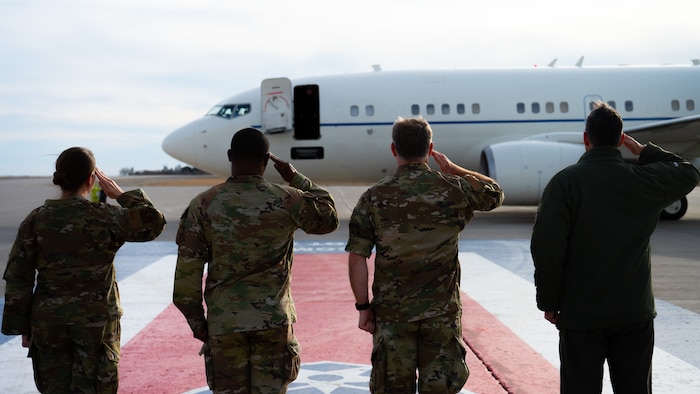
Air Force Leaders visit Minot AFB to advance Sentinel modernization
📖 Full Retelling
📚 Related People & Topics

Air force
Military branch that primarily conducts aerial warfare
An air force in the broadest sense is the national military branch that primarily conducts aerial warfare. More specifically, it is the branch of a nation's armed services that is responsible for aerial warfare as distinct from an army aviation or naval aviation units. Typically, air forces are resp...

LGM-30 Minuteman
American ICBM
The LGM-30 Minuteman is an American land-based intercontinental ballistic missile (ICBM) in service with the Air Force Global Strike Command. As of 2025, the LGM-30G (Version 3) is the only land-based ICBM in service in the United States and represents the land leg of the U.S. nuclear triad, along w...

Minot Air Force Base
US Air Force base near Minot, North Dakota
Minot Air Force Base ( MY-not; IATA: MIB, ICAO: KMIB, FAA LID: MIB) is a United States Air Force (USAF) installation in Ward County, North Dakota, thirteen miles (20 km) north of the city of Minot via U.S. Route 83. In the 2020 census, the base was counted as a CDP with a total population of 5,017,...

Intercontinental ballistic missile
Ballistic missile with a range of more than 5,500 kilometres
An intercontinental ballistic missile (ICBM) is a ballistic missile with a range greater than 5,500 kilometres (3,400 mi), primarily designed for nuclear weapons delivery (delivering one or more thermonuclear warheads). Conventional, chemical, and biological weapons can also be delivered with varyin...
Entity Intersection Graph
Connections for Air force:
View full profileMentioned Entities
Deep Analysis
Why It Matters
This visit matters because it signals the U.S. Air Force's commitment to modernizing its nuclear triad, specifically the land-based leg represented by Minuteman III missiles being replaced by Sentinel. It directly affects national security strategy, the local economy around Minot Air Force Base, and the broader defense industrial base. The modernization ensures America's nuclear deterrent remains credible against evolving threats from peer adversaries like Russia and China.
Context & Background
- The Sentinel program (formerly GBSD - Ground Based Strategic Deterrent) is a multi-decade effort to replace the aging Minuteman III ICBM system, first deployed in the 1970s.
- Minot Air Force Base in North Dakota is one of three U.S. Air Force bases that operate intercontinental ballistic missiles (ICBMs), alongside Malmstrom AFB in Montana and F.E. Warren AFB in Wyoming.
- The U.S. nuclear triad consists of land-based ICBMs, submarine-launched ballistic missiles (SLBMs), and strategic bombers, with ICBMs providing rapid response capability and complicating an adversary's first-strike calculations.
- The Sentinel program has faced scrutiny over its estimated cost, which has risen significantly, prompting congressional oversight and requiring special certification to continue.
What Happens Next
Following the visit, the Air Force will likely continue refining Sentinel deployment plans, with initial operational capability targeted for the late 2020s. Congressional defense committees will monitor cost and schedule as they deliberate future funding. The visit may precede announcements about contracting milestones or basing decisions related to infrastructure upgrades at Minot and other ICBM bases.
Frequently Asked Questions
Sentinel is the U.S. Air Force's program to replace the Minuteman III intercontinental ballistic missile system with a modernized ICBM, including updated missiles, launch control systems, and infrastructure. It aims to ensure reliability and security through the 2070s.
Minot AFB houses both B-52 strategic bombers and Minuteman III ICBMs, making it one of only two bases with dual nuclear missions. Its geographic location in the northern U.S. provides strategic positioning for missile fields and bomber operations.
The Sentinel program's estimated cost has grown to over $130 billion, a significant increase from earlier projections. This cost growth triggered a Nunn-McCurdy breach, requiring the Pentagon to certify the program's essentialness to Congress.
Key challenges include managing cost overruns, integrating new technology with legacy systems, and ensuring timely delivery amid supply chain constraints. Environmental and community impacts near missile fields also require careful mitigation.