
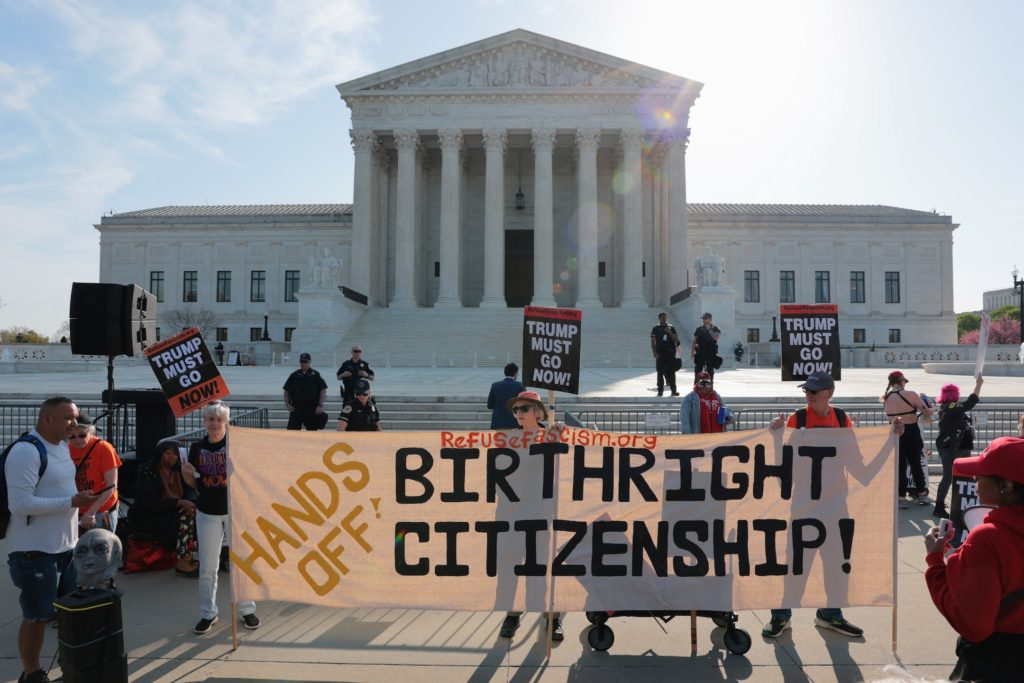
Analyzing the arguments as Supreme Court hears birthright citizenship case
#Supreme Court #birthright citizenship #14th Amendment #undocumented immigrants #jurisdiction #constitutional interpretation #immigration law
📌 Key Takeaways
- The Supreme Court is hearing a case challenging birthright citizenship under the 14th Amendment.
- Arguments focus on the interpretation of 'subject to the jurisdiction thereof' in the amendment.
- The case could redefine citizenship for children of undocumented immigrants born in the U.S.
- Legal experts debate the original intent versus modern application of the constitutional clause.
- The ruling may have significant implications for immigration policy and national identity.
📖 Full Retelling
🏷️ Themes
Constitutional Law, Immigration Policy
📚 Related People & Topics
Supreme court
Highest court in a jurisdiction
In most legal jurisdictions, a supreme court, also known as a court of last resort, apex court, high (or final) court of appeal, and court of final appeal, is the highest court within the hierarchy of courts. Broadly speaking, the decisions of a supreme court are binding on all other courts in a nat...
Entity Intersection Graph
Connections for Supreme court:
Mentioned Entities
Deep Analysis
Why It Matters
This Supreme Court case challenges the long-standing interpretation of the 14th Amendment's citizenship clause, which could fundamentally alter who is considered a U.S. citizen at birth. The outcome could affect millions of children born to undocumented immigrants and potentially reshape immigration policy for generations. This case matters to immigrant communities, policymakers, and anyone concerned with constitutional interpretation and national identity. A ruling against birthright citizenship would represent one of the most significant changes to American citizenship law in over a century.
Context & Background
- The 14th Amendment's Citizenship Clause states 'All persons born or naturalized in the United States, and subject to the jurisdiction thereof, are citizens of the United States and of the State wherein they reside.'
- Birthright citizenship has been interpreted since the 1898 Supreme Court case United States v. Wong Kim Ark to apply to nearly all children born on U.S. soil, regardless of parents' immigration status.
- Approximately 300,000-400,000 children are born to undocumented immigrants in the U.S. annually, representing about 7-8% of all U.S. births.
- The current challenge argues that children of undocumented immigrants are not 'subject to the jurisdiction' of the United States as intended by the 14th Amendment's framers.
- Previous attempts to challenge birthright citizenship through legislation have failed, making this judicial approach particularly significant.
What Happens Next
The Supreme Court will deliberate following oral arguments, with a decision expected by late June or early July 2024. If the Court rules against birthright citizenship, Congress may need to pass legislation addressing the status of affected individuals. Either outcome will likely trigger further legal challenges and legislative proposals regarding immigration and citizenship. The decision will immediately affect pending immigration cases and could influence state-level policies regarding documentation and benefits.
Frequently Asked Questions
Birthright citizenship, also called jus soli, is the principle that anyone born on a country's soil automatically becomes a citizen. In the U.S., this has been interpreted to apply to nearly all children born within its territory, regardless of their parents' immigration status.
A ruling would likely apply prospectively, meaning current citizens would not lose their status. However, it could create complex legal questions about children born between the ruling and any implementing legislation, and might affect family reunification policies.
The United States and Canada are among the few developed nations with unconditional birthright citizenship. Most European and Asian countries require at least one parent to be a citizen or legal resident for a child to gain citizenship by birth.
Opponents argue it encourages 'birth tourism,' creates an incentive for illegal immigration, and wasn't intended to apply to children of undocumented immigrants. They claim the 14th Amendment's 'subject to the jurisdiction' language excludes those owing allegiance to other nations.
These children would likely become undocumented immigrants themselves, facing potential deportation and limited access to services. Their status would depend on subsequent legislation, potentially creating a class of stateless individuals if no country claims them as citizens.