
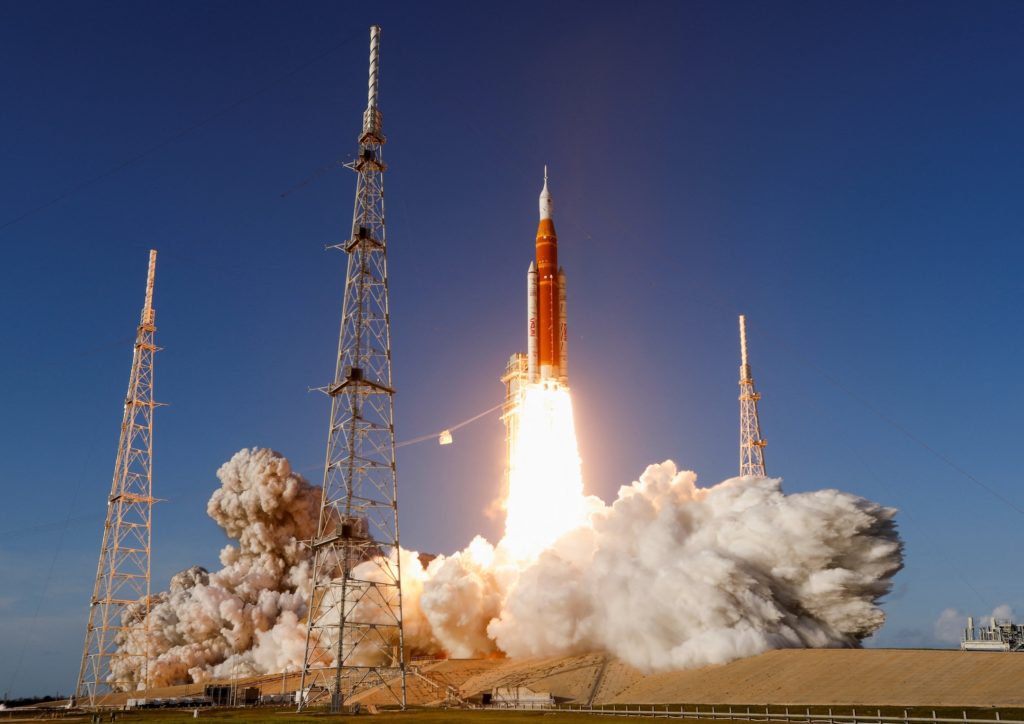
Artemis II astronauts embark on voyage around the moon
📖 Full Retelling
📚 Related People & Topics

NASA
American space and aeronautics agency
The National Aeronautics and Space Administration (NASA ) is an independent agency of the U.S. federal government responsible for the United States' civil space program and for research in aeronautics and space exploration. Headquartered in Washington, D.C., NASA operates ten field centers across th...

Artemis II
Artemis program's second lunar flight
Artemis II is a planned lunar spaceflight mission under the Artemis program, led by NASA. It is intended to be the second flight of the Space Launch System (SLS), and the first crewed mission of the Orion spacecraft. It is the first crewed mission around the Moon, and beyond low Earth orbit, since A...

Orion (spacecraft)
American crewed spacecraft for the Artemis program
Orion (Orion Multi-Purpose Crew Vehicle or Orion MPCV) is a partially reusable crewed spacecraft used in NASA's Artemis program. The spacecraft consists of a Crew Module (CM) space capsule designed by Lockheed Martin that is paired with a European Service Module (ESM) manufactured by Airbus Defence ...
Entity Intersection Graph
Connections for NASA:
Mentioned Entities
Deep Analysis
Why It Matters
This mission represents humanity's return to lunar exploration after more than 50 years, marking a crucial step toward establishing a sustainable human presence on the Moon. It directly affects NASA's international partners, commercial space companies, and scientific communities who will benefit from lunar research. The success of Artemis II validates the Orion spacecraft and Space Launch System rocket systems, which are essential for future Mars missions. This achievement also inspires global interest in STEM fields and demonstrates American leadership in deep space exploration.
Context & Background
- The last human moon mission was Apollo 17 in December 1972, ending NASA's Apollo program
- Artemis I was an uncrewed test flight that successfully orbited the Moon in late 2022
- The Artemis program aims to land the first woman and first person of color on the Moon
- NASA has partnered with ESA, CSA, JAXA, and commercial companies including SpaceX for lunar missions
- The program's long-term goal is to establish a sustainable lunar base as a stepping stone to Mars
What Happens Next
Following Artemis II's successful crewed lunar orbit, NASA will proceed with Artemis III planned for 2025-2026, which will attempt the first crewed lunar landing since Apollo. The Gateway lunar space station components will begin launching in 2024 to support surface missions. International and commercial partners will continue developing lunar landers and surface systems, with SpaceX's Starship scheduled for uncrewed lunar tests before supporting Artemis III.
Frequently Asked Questions
Artemis uses modern technology, international partnerships, and commercial involvement to establish sustainable lunar presence rather than brief visits. The program specifically aims for diversity in crew selection and plans to use reusable systems including the Gateway station orbiting the Moon.
The four astronauts will test Orion spacecraft systems in deep space, conduct scientific experiments, and demonstrate communication capabilities during their approximately 10-day journey. They will travel around the Moon without landing, reaching further from Earth than any human spacecraft in history.
The Moon serves as a proving ground for technologies needed for Mars missions, including life support systems, radiation protection, and in-situ resource utilization. Lunar operations allow NASA to develop deep space operational experience closer to Earth before attempting the much longer journey to Mars.
The crew includes NASA astronauts Reid Wiseman (commander), Victor Glover (pilot), Christina Koch (mission specialist), and Canadian Space Agency astronaut Jeremy Hansen (mission specialist). This represents the most diverse lunar crew in history, including the first woman and first person of color to travel to lunar distance.
Primary risks include radiation exposure beyond Earth's protective magnetosphere, spacecraft system failures in deep space, and the challenge of re-entering Earth's atmosphere at higher speeds than low-Earth orbit returns. The mission also tests new life support systems for extended duration in the deep space environment.