
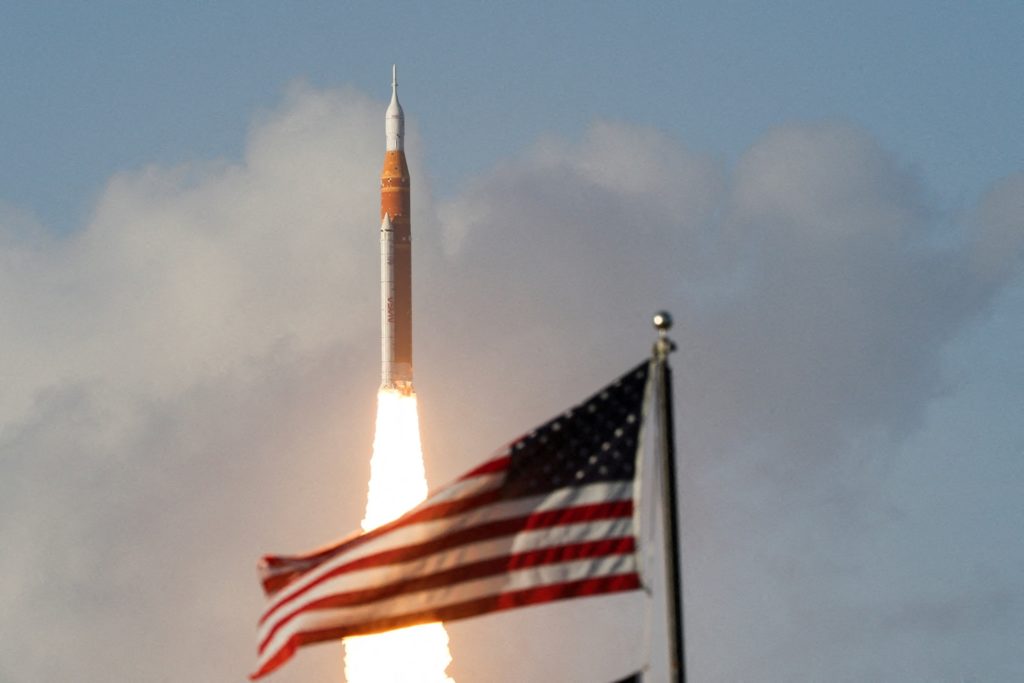
Artemis II launch sends 4 astronauts on mission around the moon
📖 Full Retelling
📚 Related People & Topics

NASA
American space and aeronautics agency
The National Aeronautics and Space Administration (NASA ) is an independent agency of the U.S. federal government responsible for the United States' civil space program and for research in aeronautics and space exploration. Headquartered in Washington, D.C., NASA operates ten field centers across th...

Artemis II
Artemis program's second lunar flight
Artemis II is a planned lunar spaceflight mission under the Artemis program, led by NASA. It is intended to be the second flight of the Space Launch System (SLS), and the first crewed mission of the Orion spacecraft. It is the first crewed mission around the Moon, and beyond low Earth orbit, since A...
Entity Intersection Graph
Connections for NASA:
Mentioned Entities
Deep Analysis
Why It Matters
This mission represents humanity's return to lunar exploration after more than 50 years, demonstrating significant advancements in space technology and international collaboration. It directly affects NASA's Artemis program timeline, international space agencies participating in lunar exploration, and the global aerospace industry. The successful launch validates new spacecraft systems that will be critical for future lunar landings and eventual Mars missions, while inspiring a new generation of scientists and engineers worldwide.
Context & Background
- The last human mission to the moon was Apollo 17 in 1972, marking over half a century since humans traveled beyond low Earth orbit
- Artemis I was an uncrewed test flight that orbited the moon in 2022, validating the Space Launch System rocket and Orion spacecraft
- The Artemis program aims to establish sustainable lunar exploration with plans for the Gateway lunar space station and Artemis III lunar landing mission
- NASA's international partners include the European Space Agency (providing Orion's service module), Canadian Space Agency (providing robotic arm technology), and other nations through the Artemis Accords
What Happens Next
The Artemis II crew will complete a 10-day mission orbiting the moon before returning to Earth, with splashdown expected in the Pacific Ocean. Following mission success, NASA will proceed with Artemis III planning for the first crewed lunar landing since Apollo, currently scheduled for no earlier than 2025. The mission data will inform final designs for lunar lander systems and Gateway components, with international partner contributions continuing through the decade.
Frequently Asked Questions
The crew includes NASA astronauts Reid Wiseman, Victor Glover, Christina Koch, and Canadian Space Agency astronaut Jeremy Hansen. This represents the most diverse lunar mission crew in history, including the first woman, first person of color, and first non-American to travel to lunar distance, reflecting international collaboration in modern space exploration.
Artemis II uses more advanced technology including the Space Launch System rocket (more powerful than Saturn V), Orion spacecraft with modern computing and life support systems, and will test new communication and navigation systems. Unlike Apollo missions that went directly to lunar orbit, Artemis missions are building toward sustainable presence with future Gateway station and lunar base plans.
Primary objectives include testing Orion's life support systems with crew aboard, validating spacecraft performance in deep space environment, testing communication systems at lunar distances, and ensuring crew safety procedures work effectively. The mission will also collect valuable data on radiation exposure and human factors during the journey beyond low Earth orbit.
Artemis II tests critical technologies needed for Mars missions including long-duration life support, deep space navigation, and radiation protection systems. The experience gained operating in cislunar space provides essential operational knowledge for the much longer journey to Mars, while international partnerships established through Artemis create frameworks for future collaborative exploration.
Orion spacecraft includes multiple redundant systems and emergency protocols, with the capability for early return trajectories if needed. Mission control maintains constant communication, and the spacecraft is designed with radiation shelters and medical equipment. Extensive simulations have prepared both crew and ground teams for various contingency scenarios throughout the mission profile.