
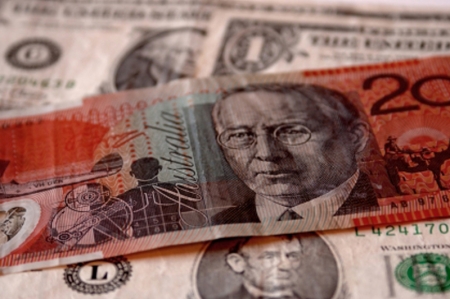
Asia FX skittish as Iran fears, Fed caution boost dollar; Aussie rises before RBA
#Asian currencies #U.S. dollar #Iran-Israel conflict #Federal Reserve #Australian dollar #Reserve Bank of Australia #safe-haven demand #geopolitical tensions
📌 Key Takeaways
- Asian currencies face pressure from geopolitical tensions in the Middle East and cautious Federal Reserve policy outlook
- The U.S. dollar strengthens as safe-haven demand rises due to Iran-Israel conflict concerns
- The Australian dollar shows resilience ahead of the Reserve Bank of Australia's upcoming policy decision
- Market sentiment remains fragile as investors weigh geopolitical risks against central bank policy trajectories
🏷️ Themes
Currency Markets, Geopolitical Risk, Central Bank Policy
📚 Related People & Topics
Australian dollar
Currency of Australia
The Australian dollar (sign: $; code: AUD; also abbreviated A$ or sometimes AU$ to distinguish it from other dollar-denominated currencies; and also referred to as the dollar or Aussie dollar) is the official currency and legal tender of Australia, including all of its external territories, and thr...

Federal Reserve
Central banking system of the US
The Federal Reserve System (often shortened to the Federal Reserve, or simply the Fed) is the central banking system of the United States. It was created on December 23, 1913, with the enactment of the Federal Reserve Act, after a series of financial panics (particularly the panic of 1907) led to th...

Reserve Bank of Australia
Central bank of Australia
The Reserve Bank of Australia (RBA) is Australia's central bank and banknote issuing authority. It has had this role since 14 January 1960, when the Reserve Bank Act 1959 removed the central banking functions from the Commonwealth Bank. The bank's main policy role is to control inflation levels with...
Entity Intersection Graph
Connections for Australian dollar:
Mentioned Entities
Deep Analysis
Why It Matters
This news matters because it highlights how geopolitical tensions and central bank policies are creating volatility in Asian financial markets, affecting investors, exporters, and importers across the region. The combination of Middle East instability and U.S. monetary policy uncertainty is driving capital flows toward safe-haven assets like the U.S. dollar, potentially increasing borrowing costs and trade imbalances for Asian economies. The Australian dollar's movement ahead of the RBA decision shows how individual central bank actions can create divergence within regional currencies, impacting trade competitiveness and investment decisions.
Context & Background
- Asian currencies have been sensitive to U.S. Federal Reserve policy since the 2013 'taper tantrum' when emerging markets saw massive capital outflows
- Iran has been under U.S. sanctions since 2018, creating periodic tensions that affect global oil prices and risk sentiment
- The RBA has maintained relatively hawkish policy compared to other developed market central banks, keeping rates at 4.35% since November 2023
- The U.S. dollar index has strengthened approximately 4% in 2024 as persistent inflation delayed expected Fed rate cuts
- Many Asian economies including China, Japan and South Korea run significant trade surpluses with the U.S., making their currencies vulnerable to dollar strength
What Happens Next
The RBA will announce its rate decision on Tuesday, with markets pricing a 40% chance of a hike; if implemented, this could provide temporary support to the Aussie dollar. Traders will monitor Fed Chair Powell's speeches this week for clues on U.S. rate trajectory, with the next FOMC meeting scheduled for May 1. Geopolitical developments in the Middle East will continue to drive risk sentiment, particularly if Iran-Israel tensions escalate further. Asian central banks may intervene in currency markets if depreciation accelerates, with Japan's Ministry of Finance having previously intervened around 152 yen/dollar.
Frequently Asked Questions
Asian currencies typically weaken against a stronger dollar because investors seek safe-haven assets during uncertainty, and many Asian economies have export-dependent growth models that suffer when their currencies appreciate too much. Central banks in the region often tolerate some depreciation to maintain trade competitiveness, especially when facing economic headwinds from China's slowdown and global demand weakness.
Iran tensions could spike oil prices, which would hurt Asian economies as most are net energy importers, increasing inflation and trade deficits. Geopolitical uncertainty also triggers capital outflows from riskier Asian assets to safer U.S. Treasury bonds, putting additional downward pressure on regional currencies and potentially forcing central banks to raise interest rates to defend their currencies.
The Australian dollar is rising because markets anticipate the RBA might maintain or even increase its hawkish stance amid persistent inflation, making Australian assets more attractive relative to other currencies. Australia's higher interest rates compared to other developed markets create yield differentials that attract carry trade investors, especially when global risk sentiment is fragile.
When the Fed signals higher-for-longer rates or delays cuts, it strengthens the dollar as U.S. assets offer better returns, drawing capital away from Asian markets. This forces Asian central banks to choose between defending their currencies with potentially growth-harming rate hikes or allowing depreciation that increases import costs and inflation.
Currencies of countries with high external debt in dollars (like Indonesia), large current account deficits (like Philippines), or heavy energy imports (like India and Thailand) are most vulnerable. The Japanese yen is particularly sensitive as the Bank of Japan maintains ultra-low rates while other central banks keep rates high, creating massive interest rate differentials.