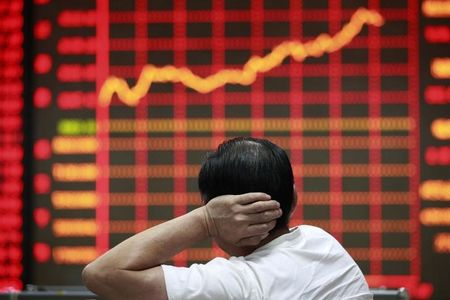
US and Israel's attack on Iran caused Asian stocks to fall sharply on Monday
Oil prices surged due to fears of Middle East supply disruptions
Investors moved to safe havens amid heightened geopolitical tensions
Asian markets were also pressured by tech sector losses and economic policy uncertainty
📖 Full Retelling
US and Israel's weekend attack on Iran, which killed hundreds including Supreme Leader Ayatollah Khamenei, triggered a sharp decline in Asian stock markets on Monday as oil prices surged and investors fled risk assets amid escalating Middle East tensions. Regional markets from Japan to India fell across the board, with Hong Kong's Hang Seng index sliding 2.4% and Japan's Nikkei 225 dropping 1.6%, reflecting broad-based risk aversion. The attack represented a significant escalation in Middle East hostilities, with Iran retaliating by launching strikes across several Middle Eastern countries and U.S. bases in the region, while both Washington and Tel Aviv signaled continued military operations against Tehran. As investors scrambled for safe havens, gold prices jumped 2% while oil prices climbed sharply, with analysts warning that $100+ oil could return if disruptions in the vital Strait of Hormuz worsen, creating significant inflationary headwinds for Asian economies heavily reliant on imported crude. Beyond geopolitical concerns, Asian markets faced additional pressures from technology sector losses, with software stocks particularly affected by investor uncertainty over artificial competition, while upcoming political meetings in China and divergent monetary policy signals from regional central banks added to market volatility.
🏷️ Themes
Geopolitical Risk, Market Volatility, Energy Security, Economic Policy
In economics and finance, risk aversion is the tendency of people to prefer outcomes with low uncertainty to those outcomes with high uncertainty, even if the average outcome of the latter is equal to or higher in monetary value than the more certain outcome.
Risk aversion explains the inclination ...
The price of oil, or the oil price, generally refers to the spot price of a barrel (159 litres) of benchmark crude oil—a reference price for buyers and sellers of crude oil such as West Texas Intermediate (WTI), Brent Crude, Dubai Crude, OPEC Reference Basket, Tapis crude, Bonny Light, Urals oil, Is...
The US-Iran conflict is causing significant global market volatility by increasing geopolitical risk and impacting energy prices. This affects Asian economies that rely on oil imports and creates uncertainty for investors.
Context & Background
US and Israel attacked Iran over the weekend
Iran retaliated with strikes across Middle East
Oil prices surged due to potential supply disruptions
What Happens Next
Markets will likely remain volatile as conflict continues. Oil price movements could impact inflation expectations in Asia. US-China economic policy developments during upcoming political meetings may also influence markets.
Frequently Asked Questions
Why are Asian stocks falling?
Asian stocks are sliding due to increased geopolitical risk from the US-Iran conflict, which has pushed oil prices higher and triggered a flight to safer assets.
What impact does this have on energy prices?
Oil prices surged as markets fear potential supply disruptions in the Middle East caused by ongoing conflicts.
}
Original Source
try{ var _=i o; . if(!_||_&&typeof _==="object"&&_.expiry Oil prices surge after US-Israel strikes on Iran, trim early gains Gold prices jump 2% amid widening US-Israel conflict with Iran Middle East tensions rise as Iran promises retaliation $100+ oil back in play if Hormuz disruption worsens: analysts (South Africa Philippines Nigeria) Asia stocks slide as US-Iran strikes batter risk appetite By Ambar Warrick Author Ambar Warrick Stock Markets Published 03/01/2026, 09:37 PM Asia stocks slide as US-Iran strikes batter risk appetite 0 AXJO -0.40% JP225 -1.55% NSEI -1.25% SSEC -0.12% TOPX -1.62% CSI300 -0.21% Investing.com-- Asian stocks fell sharply on Monday after the U.S. and Israel attacked Iran over the weekend, pushing up oil prices and spurring a broader rush out of risk and into safe havens. Regional markets took a weak lead-in from Wall Street’s Friday session, as uncertainty over artificial intelligence and interest rates dented U.S. stocks. ESH26 fell 0.6% by 20:58 ET (01:58 GMT), trimming some of their initial losses. Find out which Asian stocks are best-positioned for 2026 by upgrading to InvestingPro Asian stocks slide as US-Iran strikes drum up risk aversion Hong Kong’s Hang Seng index and Japan’s Nikkei 225 were among the worst performers in Asia, sliding 2.4% and 1.6%, respectively. The two were also pressured by losses in tech stocks. Japan’s TOPIX index shed 1.6%, while China’s Shanghai Shenzhen CSI 300 and Shanghai Composite indexes fell 0.6% and 0.5%, respectively. Australia’s ASX 200 fell 0.5%, Singapore’s Straits Times index shed 1.8%, while futures for India’s Nifty 50 index slid 0.8%. Markets fell across the board after the U.S. and Israel attacked Iran over the weekend, killing hundreds, including Supreme Leader Ayatollah Khamenei and several other top officials. Iran retaliated by launching strikes across several Middle Eastern countries and U.S. bases in the region. The conflict showed few signs of ceasing, with U.S. and Israeli leaders si...