
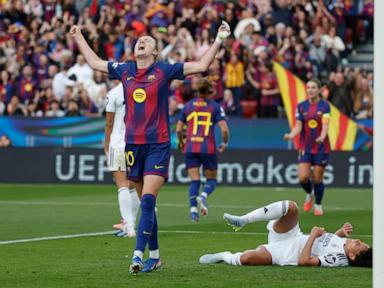
Barcelona hosts Real Madrid with a 6-2 lead in the Women’s Champions League quarterfinals
📖 Full Retelling
📚 Related People & Topics
Real Madrid CF
Association football club in Spain
Real Madrid Club de Fútbol (Spanish pronunciation: [reˈal maˈðɾið ˈkluβ ðe ˈfuðβol] ), commonly referred to as Real Madrid, is a Spanish professional association football club based in Madrid. The club competes in La Liga, the top tier of Spanish football. Founded in 1902 as Madrid Football Club, th...

UEFA Champions League
European association football tournament
The UEFA Champions League (UCL or UEFA CL), commonly known as the Champions League, is an annual club association football competition organised by the Union of European Football Associations (UEFA) that is contested by top-division European clubs. The competition begins with a round robin league ph...

Barcelona
City in Catalonia, Spain
Barcelona is a city on the northeastern coast of Spain. It is the capital and largest city of the autonomous community of Catalonia, as well as the second-most populous municipality of Spain. With a population of 1.7 million within city limits, its urban area extends to numerous neighbouring municip...
Entity Intersection Graph
Connections for Real Madrid CF:
Mentioned Entities
Deep Analysis
Why It Matters
This match represents a significant moment in women's football, showcasing the growing rivalry between two of Europe's top clubs and highlighting the increasing competitiveness and visibility of the Women's Champions League. It matters to football fans globally as Barcelona's dominant first-leg performance positions them as strong contenders for the championship, while Real Madrid faces a monumental challenge to overcome the deficit. The outcome will influence the semifinal matchups and potentially shape the trajectory of women's club football in Spain and beyond.
Context & Background
- Barcelona Femení has emerged as a powerhouse in women's football, winning the UEFA Women's Champions League in 2021 and 2023, and dominating domestic competitions in recent years.
- Real Madrid Femenino was established in 2020 after acquiring CD Tacon's license, marking their entry into top-tier women's football and quickly becoming a competitive force in Spain and Europe.
- The rivalry between Barcelona and Real Madrid, known as 'El Clásico,' is one of the most intense in football history, traditionally focused on men's teams but now expanding to women's football with increasing significance.
- The Women's Champions League has grown substantially in prestige and viewership, with record attendance and broadcasting deals reflecting rising interest in women's club football across Europe.
What Happens Next
Barcelona will likely advance to the semifinals given their substantial aggregate lead, where they could face top European clubs like Chelsea, Lyon, or Paris Saint-Germain. The second leg will be closely watched for any potential comeback attempt by Real Madrid, though Barcelona's strong home record makes this unlikely. Post-match analysis will focus on Barcelona's tactical approach and whether they rest key players ahead of domestic fixtures, while Real Madrid will evaluate their European campaign and plan for future seasons.
Frequently Asked Questions
Barcelona only needs to avoid losing by more than four goals to advance, given their 6-2 aggregate lead. Even a narrow defeat would see them through to the next round, making their position extremely secure.
While Real Madrid's men's team has historic comebacks in European competitions, their women's team is relatively new and hasn't faced such scenarios in the Champions League. Overcoming a four-goal deficit in women's football is exceptionally rare at this level.
For Barcelona, forwards like Aitana Bonmatí (Ballon d'Or winner) and Caroline Graham Hansen are crucial, while Real Madrid will rely on players like Linda Caicedo and Hayley Raso to create scoring opportunities and attempt a comeback.
Barcelona's likely advancement strengthens their status as tournament favorites, potentially setting up high-profile semifinal clashes. It also highlights the competitive gap between top clubs and emerging teams, influencing future tournament seeding and investment in women's football.
This Clásico showcases the quality of Spanish women's football on a European stage, potentially boosting domestic league visibility and inspiring younger players. It also reinforces Barcelona's dominance while challenging Real Madrid to invest further to close the gap.