
Breaking down Supreme Court ruling in Colorado conversion therapy case
📖 Full Retelling
📚 Related People & Topics
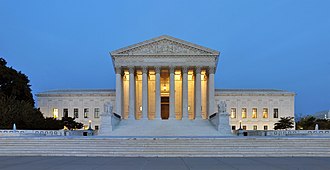
Supreme court
Highest court in a jurisdiction
In most legal jurisdictions, a supreme court, also known as a court of last resort, apex court, high (or final) court of appeal, and court of final appeal, is the highest court within the hierarchy of courts. Broadly speaking, the decisions of a supreme court are binding on all other courts in a nat...

First Amendment to the United States Constitution
1791 amendment limiting government restriction of civil liberties
The First Amendment (Amendment I) to the United States Constitution prevents Congress from making laws respecting an establishment of religion; prohibiting the free exercise of religion; or abridging the freedom of speech, the freedom of the press, the freedom of assembly, or the right to petition t...

Colorado
U.S. state
Colorado is a landlocked state in the Western United States. It is one of the Mountain states, and part of the Southwestern United States, sharing the Four Corners region with Arizona, New Mexico, and Utah. It is also bordered by Wyoming to the north, Nebraska to the northeast, Kansas to the east, a...
Entity Intersection Graph
Connections for Supreme court:
Mentioned Entities
Deep Analysis
Why It Matters
This Supreme Court ruling matters because it addresses the constitutionality of state-level bans on conversion therapy, a practice widely condemned by major medical and mental health organizations. The decision affects LGBTQ+ youth who may be subjected to these harmful practices, mental health professionals who must navigate state regulations, and religious organizations that view such therapy as part of their religious expression. The ruling sets a precedent for how First Amendment protections intersect with state authority to regulate medical practices deemed harmful, potentially influencing similar laws in other states.
Context & Background
- Conversion therapy refers to practices aimed at changing an individual's sexual orientation or gender identity, which major medical associations like the American Psychological Association and American Medical Association have condemned as ineffective and harmful.
- Colorado passed its conversion therapy ban in 2019, joining over 20 other states and numerous municipalities that have enacted similar protections for minors.
- Previous legal challenges to conversion therapy bans have produced mixed rulings, with some courts upholding them as consumer protection measures while others have struck them down as violations of free speech or religious freedom.
- The Supreme Court has previously shown interest in this issue, having declined to hear similar cases in recent years but granting certiorari in this Colorado case, signaling its importance.
What Happens Next
Following this ruling, states with existing conversion therapy bans may need to review and potentially revise their laws to comply with the Court's constitutional interpretation. Legal challenges to similar bans in other states are likely to increase, with litigants citing this precedent. Mental health professional organizations may issue updated guidance for practitioners operating in states where such bans are affected. Additional legislation at both state and federal levels could be introduced to address the ruling's implications, potentially leading to new legal battles over the scope of regulation versus constitutional protections.
Frequently Asked Questions
The Supreme Court ruled on whether Colorado's ban on conversion therapy for minors violates the First Amendment rights of therapists or religious counselors. The decision determined whether such bans constitute permissible regulation of professional conduct or unconstitutional restrictions on speech and religious practice.
This ruling creates binding precedent that will influence how similar laws in other states are interpreted and enforced. States with identical or similar bans may need to modify their regulations, while states considering such bans will need to draft legislation that accounts for the Court's constitutional analysis.
Major medical organizations argue conversion therapy is psychologically harmful, increases suicide risk among LGBTQ+ youth, and lacks scientific validity. These organizations maintain that sexual orientation and gender identity are not disorders requiring treatment, making attempts to change them unethical and dangerous.
The ruling clarifies the extent to which religious counselors and organizations can claim First Amendment protections when providing conversion therapy. It determines whether religious exemptions apply or if states can regulate such practices uniformly regardless of the provider's religious affiliation or motivations.
The ruling directly affects the legal protections available to LGBTQ+ youth seeking to avoid conversion therapy. Depending on the outcome, minors in Colorado and potentially other states may have varying levels of protection from these practices, which could influence their mental health outcomes and access to affirming care.