
Bull vs. bear argument on Friday’s Supreme Court tariff ruling
#Supreme Court #Tariffs #Wall Street #Trade policy #Emergency powers #Market impact #Section 232
📌 Key Takeaways
- Supreme Court struck down key emergency-powers tariffs
- Wall Street analysts divided on market impact
- Decision limits presidential tariff authority under Section 232
- Uncertainty about future trade policy direction
📖 Full Retelling
🏷️ Themes
Trade Policy, Market Analysis, Legal Developments
📚 Related People & Topics
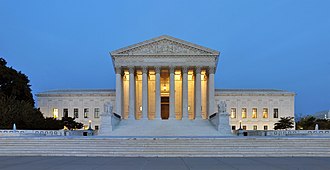
Supreme court
Highest court in a jurisdiction
In most legal jurisdictions, a supreme court, also known as a court of last resort, apex court, high (or final) court of appeal, and court of final appeal, is the highest court within the hierarchy of courts. Broadly speaking, the decisions of a supreme court are binding on all other courts in a nat...

State of emergency
Declaration by a government allowing assumption of extraordinary power
A state of emergency is a situation in which a government is empowered to put through policies that it would normally not be permitted to do, for the safety and protection of its citizens. A government can declare such a state before, during, or after a natural disaster, civil unrest, armed conflict...

Commercial policy
Government's policy governing international trade
A commercial policy (also referred to as a trade policy or international trade policy) is a government's policy governing international trade. Commercial policy is an all encompassing term that is used to cover topics which involve international trade. Trade policy is often described in terms of a ...

Wall Street
Street in Manhattan, New York
# Wall Street **Wall Street** is a historic thoroughfare located in the Financial District of Lower Manhattan, New York City. Spanning approximately eight city blocks, it extends just under 2,000 feet (0.6 km) from Broadway in the west to South Street and the East River in the east. ### Geography ...

Tariff
Goods import or export tax
A tariff or import tax is a duty imposed by a national government, customs territory, or supranational union on imports of goods and is paid by the importer. Exceptionally, an export tax may be levied on exports of goods or raw materials and is paid by the exporter. Besides being a source of revenue...
Entity Intersection Graph
Connections for Supreme court:
Mentioned Entities
Deep Analysis
Why It Matters
The Supreme Court's ruling on emergency-powers tariffs is significant because it directly impacts the executive branch's ability to impose trade restrictions, which can affect corporate costs, supply chains, and inflation. This decision creates market uncertainty as investors assess the implications for international trade relations and specific sectors.
Context & Background
- The ruling struck down key tariffs imposed using emergency powers
- The decision limits presidential authority to enact certain trade measures
- The tariffs were a major part of recent U.S. trade policy
What Happens Next
Legal experts will analyze the ruling's full implications for future trade actions. Market participants will monitor for potential legislative responses from Congress to address the power void.
Frequently Asked Questions
The Supreme Court struck down key tariffs that were imposed using presidential emergency powers.
Investors are debating whether limiting presidential tariff powers will reduce trade uncertainty or create new economic risks.
Sectors heavily involved in international trade, such as manufacturing and agriculture, are most directly affected.