Clouds remain the biggest source of uncertainty in climate predictions
Current supercomputers lack the power to directly simulate cloud behavior at required resolution
Two main approaches are emerging: improving physics-based models with AI and developing AI systems that predict directly from data
The CLIMA collaboration has developed a climate model twice as accurate as previous ones
Accurate cloud modeling is critical as it determines whether we face 2°C or 6°C of warming
📖 Full Retelling
Climate physicists and computer scientists led by researchers at the California Institute of Technology, Allen Institute for Artificial Intelligence, and University of Connecticut are racing to solve the cloud modeling problem in Washington state and beyond on February 20, 2026, because clouds remain the biggest source of uncertainty in climate predictions, with current supercomputers unable to accurately simulate their complex behavior that could determine whether the planet warms by 2°C or 6°C this century. The challenge stems from the fact that clouds, which both reflect sunlight and trap heat, operate at scales too small for even the world's most powerful supercomputers to directly simulate in global climate models, forcing researchers to rely on parameterized approximations that introduce significant uncertainty into predictions. Over the past two decades, since researcher Chris Bretherton began collecting cloud data from flights across Chile, California, Hawai'i, and Antarctica, the globe has warmed by roughly half a degree Celsius, yet cloud modeling techniques have struggled to keep pace with this changing climate. Two competing approaches have emerged: Tapio Schneider's Climate Modeling Alliance (CLIMA) is using AI to improve physics-based models by training algorithms on a library of 8,000 digital clouds created in collaboration with Google, while Bretherton is developing AI tools that predict climate behavior directly from real-world data with minimal reliance on traditional physics equations. Both teams share a sense of urgency as climate changes rapidly, with Schneider noting that 'having a perfect model in 100 years will not be useful for solving the climate crisis,' and CLIMA researchers claiming their new model is already twice as accurate as previous generations.
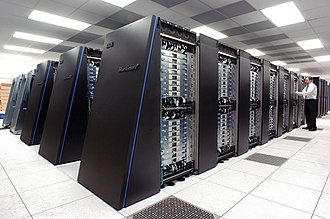
A supercomputer is a type of computer with a high level of performance as compared to a general-purpose computer. Supercomputers play an important role in the field of computational science, and are used for a wide range of computationally intensive tasks in various fields including quantum mechanic...
Hypothetical representation of potential future conditions
A climate change scenario is a hypothetical future based on a "set of key driving forces". Scenarios explore the long-term effectiveness of mitigation and adaptation.
Scenarios help to understand what the future may hold.
# Artificial Intelligence (AI)
**Artificial Intelligence (AI)** is a specialized field of computer science dedicated to the development and study of computational systems capable of performing tasks typically associated with human intelligence. These tasks include learning, reasoning, problem-solvi...
Clouds are the biggest source of uncertainty in climate predictions, affecting how much the planet will warm. Improving cloud representation in models can reduce the spread in projected temperatures and help policymakers plan for future risks.
Context & Background
Clouds influence both solar reflection and heat trapping
Current supercomputers cannot resolve cloud microphysics directly
Physicists use parameterizations and AI to approximate cloud effects
What Happens Next
Researchers are training AI on thousands of high‑resolution cloud simulations to automate parameter selection, aiming for a model twice as accurate. The next step is to deploy the new CLIMA model at a conference and integrate it into global forecasting systems.
Frequently Asked Questions
Why are clouds hard to model?
Their tiny structures and complex interactions require far more computational power than current supercomputers can provide.
What role does AI play?
AI learns from detailed cloud simulations to predict cloud behavior without solving full fluid equations.
When will the new model be available?
It will be unveiled at a conference in Japan in March and then released to the scientific community.
Will this reduce climate uncertainty?
Yes, by improving cloud representation the spread of temperature projections is expected to shrink.
}
Original Source
Home Climate Physicists Face the Ghosts in Their Machines: Clouds Read Later Share Copied! Comments Read Later Read Later climate models Climate Physicists Face the Ghosts in Their Machines: Clouds By Charlie Wood February 20, 2026 The planet is getting hotter, but one factor in particular makes it hard to tell just how hot it will get. Physicists and computer scientists are racing to solve the problem of clouds. Read Later Introduction In October 2008, Chris Bretherton lifted off from the coast of northern Chile in a C-130 turboprop plane. It was too dark to see the sandy hills of the Atacama Desert below, but the darkness suited Bretherton just fine. The researcher wasn’t going sightseeing. Seated directly behind the pilots, he kept his focus entirely on the sky. The plane was stuffed with instruments, and its wings bristled with sensors and other devices. Bretherton’s immediate mission was to help the pilots collect information about the ice, water vapor, and air pressure around them. His longer-term goal was to use that data — as well as data he would collect over California, Hawai‘i, and Antarctica — to deal with one of the most challenging factors in climate science: clouds. The plane passed a fluffy cumulus, and Bretherton spotted a rainbowlike prism of colors. This was strange; the cloud seemed too thin to host the large droplets required to refract light in this way. “The six-to-nine-hour flights rarely get boring,” Bretherton said, “because we always run into surprising cloud structures that rattle our scientific preconceptions.” He would later conclude that the air must have been so pristine that the cloud’s vapor was condensing into unusually large droplets on an unusually small number of particles. In the nearly two decades since Bretherton boarded that plane, the globe has warmed by roughly half a degree Celsius. And clouds, which both reflect sunlight and trap heat, are still the biggest source of uncertainty in climate predictions. The world’s top su...