
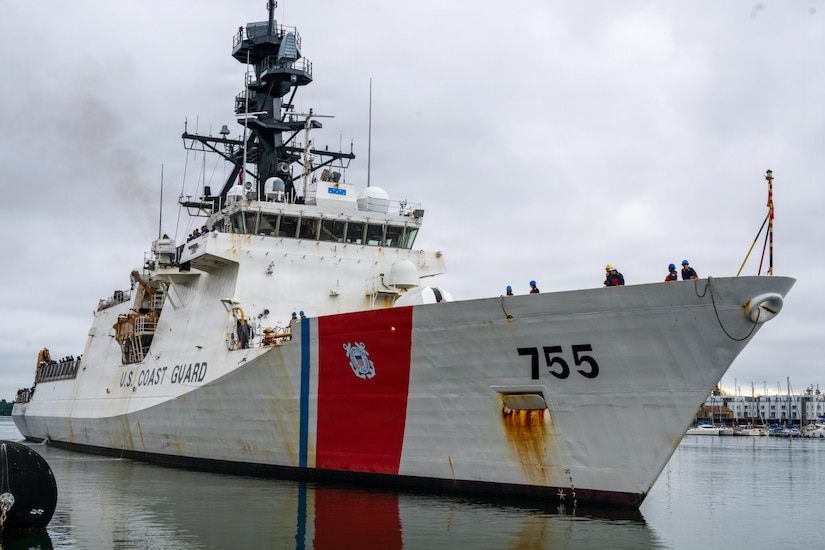
Coast Guard Cutter Munro Returns Home After 4-Month, Multimission Patrol Seizing More Than 20,000 Pounds of Cocaine
#Coast Guard #Munro #cocaine seizure #Eastern Pacific #patrol #drug trafficking #maritime operations
📌 Key Takeaways
- Coast Guard Cutter Munro completed a 4-month patrol in the Eastern Pacific Ocean.
- The patrol seized over 20,000 pounds of cocaine, disrupting drug trafficking.
- The mission involved multiple operations, including counter-drug and search-and-rescue.
- The crew returned to homeport, highlighting Coast Guard's maritime security role.
📖 Full Retelling
🏷️ Themes
Drug Interdiction, Maritime Security
📚 Related People & Topics

Coast guard
Maritime security organization
A coast guard or coastguard is a maritime security organization of a particular country. The term embraces wide range of responsibilities in different countries, from being a heavily armed military force with customs and security duties to being a volunteer organization tasked with search and rescue...

Pacific Ocean
Largest ocean
The Pacific Ocean is the largest and deepest of Earth's five oceanic divisions. It stretches from the Arctic Ocean in the north to the Southern Ocean, or, depending on the definition, to Antarctica in the south, and is bounded by the continents of Asia and Australia in the west and the Americas in t...

Munro
Scottish peak over 3,000 ft and listed on the SMC tables
A Munro (; Scottish Gaelic: Rothach) is defined as a mountain in Scotland with a height over 3,000 feet (914.4 m), and which is on the Scottish Mountaineering Club (SMC) official list of Munros; there is no explicit topographical prominence requirement. The best known Munro is Ben Nevis (Beinn Nibhe...
Entity Intersection Graph
Connections for Coast guard:
Mentioned Entities
Deep Analysis
Why It Matters
This seizure represents a significant blow to transnational drug trafficking organizations, disrupting their supply chains and revenue streams. The operation affects national security by reducing the flow of illegal narcotics into the United States, which contributes to overdose deaths and fuels criminal activity. It demonstrates ongoing U.S. maritime interdiction efforts in the Eastern Pacific, a primary transit zone for cocaine shipments from South America. The successful patrol also highlights the Coast Guard's critical role in counter-drug operations and maritime law enforcement.
Context & Background
- The Eastern Pacific Ocean is a major transit route for cocaine trafficking from source countries like Colombia, Peru, and Bolivia to North American markets.
- The U.S. Coast Guard has conducted counter-drug operations in this region for decades, often in coordination with international partners and other U.S. agencies.
- Cocaine seizures at sea have increased in recent years as traffickers adapt to land-based interdiction efforts by using maritime routes.
- The Coast Guard Cutter Munro is a Legend-class national security cutter, one of the most advanced vessels in the fleet, designed for extended offshore patrols.
- Previous large seizures include a 2020 operation where the Coast Guard intercepted over 39,000 pounds of cocaine worth approximately $569 million.
What Happens Next
The seized cocaine will be processed as evidence, potentially leading to investigations and prosecutions of trafficking networks. The Munro will undergo maintenance and crew rest before its next deployment. Intelligence gathered during the patrol will inform future interdiction operations and targeting of specific trafficking organizations. The Coast Guard will likely continue and possibly intensify patrols in the Eastern Pacific during peak trafficking seasons.
Frequently Asked Questions
The street value of 20,000 pounds of cocaine is estimated at approximately $300-400 million, depending on purity and distribution level. This represents a major financial loss for trafficking organizations and prevents significant quantities from reaching communities.
Most cocaine seized in the Eastern Pacific originates from South American source countries, primarily Colombia, Peru, and Bolivia. Traffickers use go-fast boats, fishing vessels, and semi-submersibles to transport drugs northward through international waters.
The cocaine is taken as evidence, documented, and transported to secure facilities. It is eventually destroyed through incineration or other approved methods after legal proceedings are complete. The evidence supports prosecutions of traffickers and investigations into their networks.
The Coast Guard uses intelligence, surveillance, reconnaissance assets, and international partnerships to detect suspicious vessels. Once identified, law enforcement teams board and search vessels, often with support from helicopters and pursuit boats. They operate under both U.S. and international law authorities.
Beyond counter-drug operations, these patrols typically include search and rescue, fisheries enforcement, migrant interdiction, and maritime security missions. The Coast Guard's multimission capability allows it to address various threats and emergencies across vast ocean areas.