
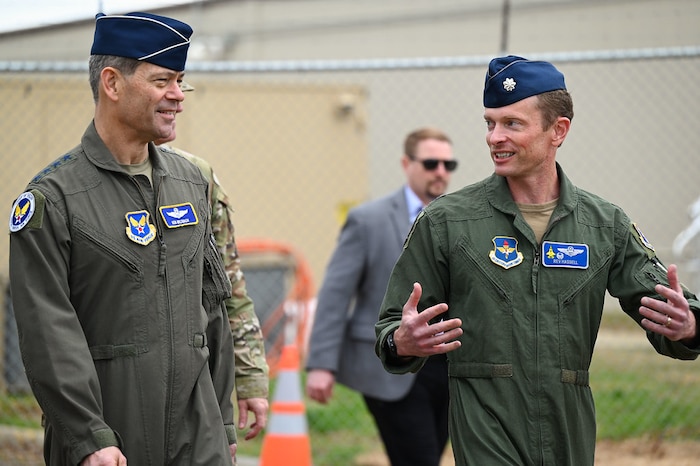
CSAF, CMSAF highlight AETC’s strategic impact on force readiness
#CSAF #CMSAF #AETC #force readiness #strategic impact #Air Force #training #military leadership
📌 Key Takeaways
- CSAF and CMSAF emphasized AETC's role in enhancing Air Force readiness.
- AETC's training programs are crucial for developing skilled personnel.
- The focus is on strategic alignment with future operational needs.
- Leadership highlighted AETC's contributions to overall force preparedness.
📖 Full Retelling
🏷️ Themes
Military Training, Force Readiness
📚 Related People & Topics

Chief Master Sergeant of the Air Force
Senior enlisted member of the US Air Force
The chief master sergeant of the Air Force (acronym: CMSAF) is a unique non-commissioned rank in the United States Air Force. The holder of this rank and position of office represents the highest enlisted level of leadership in the Air Force, unless an enlisted airman is serving as the senior enlist...

Air force
Military branch that primarily conducts aerial warfare
An air force in the broadest sense is the national military branch that primarily conducts aerial warfare. More specifically, it is the branch of a nation's armed services that is responsible for aerial warfare as distinct from an army aviation or naval aviation units. Typically, air forces are resp...

Chief of Staff of the United States Air Force
Senior-most officer and service chief of the United States Air Force
The chief of staff of the Air Force (acronym: CSAF, or AF/CC) is the service chief of the United States Air Force. They are the principal military advisor to the secretary of the Air Force on matter pertaining to the Air Force. They are a member of the Joint Chiefs of Staff, and thereby a military a...
Entity Intersection Graph
Connections for Chief Master Sergeant of the Air Force:
View full profileMentioned Entities
Deep Analysis
Why It Matters
This news matters because Air Education and Training Command (AETC) is responsible for developing the entire Air Force workforce, from pilots to maintainers to support personnel. The public endorsement by the Air Force's top uniformed leader (CSAF) and top enlisted leader (CMSAF) signals institutional prioritization of training quality and pipeline development. This affects current and future airmen, operational commanders who receive trained personnel, and taxpayers who fund defense readiness programs.
Context & Background
- AETC is one of the U.S. Air Force's nine Major Commands, headquartered at Joint Base San Antonio-Randolph, Texas.
- The command oversees all Air Force initial skills training, flight training, professional military education, and technical training.
- Force readiness has been a persistent concern across military branches due to aging equipment, recruitment challenges, and evolving global threats.
- Recent conflicts have highlighted the importance of well-trained personnel in maintaining technological and tactical advantages.
What Happens Next
AETC will likely receive continued high-level visibility and potentially increased resources to address training pipeline bottlenecks. Expect follow-on initiatives focusing on modernizing training methods, accelerating production of critical career fields, and integrating new technologies like simulators and AI-assisted learning. The next public milestone may be AETC's budget testimony before congressional committees.
Frequently Asked Questions
CSAF stands for Chief of Staff of the Air Force, the highest-ranking uniformed officer. CMSAF stands for Chief Master Sergeant of the Air Force, the highest-ranking enlisted advisor to the CSAF.
AETC produces approximately 90% of all Air Force personnel through initial training pipelines. Without effective training commands, operational units cannot receive qualified replacements or new personnel with necessary skills.
Current members may see updated training curricula, new professional development opportunities, and potential changes to career progression timelines based on AETC's strategic adjustments.
AETC contends with instructor shortages, aging training aircraft, adapting to new technologies like drones and cyber warfare, and meeting increased demand for specialized career fields.