

DHS asks Supreme Court to end Haitians' temporary legal protections
#DHS #Supreme Court #Haitians #Temporary Protected Status #immigration #legal protections #Haiti
📌 Key Takeaways
- DHS requests Supreme Court to terminate Temporary Protected Status for Haitians
- Legal protections for Haitian immigrants are at risk of ending
- The case could impact thousands of Haitian nationals in the U.S.
- The move follows ongoing review of country conditions in Haiti
📖 Full Retelling
🏷️ Themes
Immigration Policy, Legal Proceedings
📚 Related People & Topics

United States Department of Homeland Security
United States federal executive department
The United States Department of Homeland Security (DHS) is the U.S. federal executive department responsible for public security, roughly comparable to the interior, home, or public security ministries in other countries. Its missions involve anti-terrorism, civil defense, immigration and customs, b...

Haitians
Inhabitants of Haiti and their descendants in the Haitian diaspora
Haitians (Haitian Creole: Ayisyen, French: Haïtiens) are the citizens and nationals of Haiti. The Haitian people have their origins in West and Central Africa with the most spoken language being Haitian Creole. The larger Haitian diaspora includes individuals that trace ancestry to Haiti and self-id...
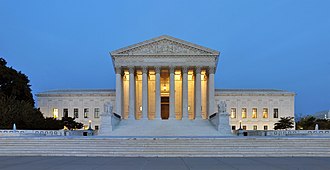
Supreme court
Highest court in a jurisdiction
In most legal jurisdictions, a supreme court, also known as a court of last resort, apex court, high (or final) court of appeal, and court of final appeal, is the highest court within the hierarchy of courts. Broadly speaking, the decisions of a supreme court are binding on all other courts in a nat...
Temporary protected status
Temporary status for eligible nationals who reside in the United States
Temporary protected status (TPS) is given by the United States government to eligible nationals of designated countries, as determined by the Secretary of Homeland Security, who are present in the United States. In general, the Secretary of Homeland Security may grant temporary protected status to p...

Haiti
Country in the Caribbean
Haiti, officially the Republic of Haiti, is a country in the Caribbean on the island of Hispaniola in the Caribbean Sea, east of Cuba and Jamaica and south of the Bahamas. It occupies the western side of the island, which it shares with the Dominican Republic. Haiti is the third largest country in t...
Entity Intersection Graph
Connections for United States Department of Homeland Security:
Mentioned Entities
Deep Analysis
Why It Matters
This legal action directly affects approximately 55,000 Haitian immigrants currently protected under Temporary Protected Status (TPS), potentially forcing them to return to a country still recovering from political instability, natural disasters, and humanitarian crises. The decision could set a precedent for how the U.S. government handles TPS designations for other national groups, impacting broader immigration policy. This matters to Haitian-American communities, employers who rely on TPS holders, and advocates concerned about returning people to unsafe conditions. The outcome will also influence U.S.-Haiti diplomatic relations and humanitarian considerations.
Context & Background
- Temporary Protected Status (TPS) was established by Congress in 1990 to provide temporary legal status to nationals of countries experiencing armed conflict, natural disasters, or other extraordinary conditions.
- Haiti was initially designated for TPS in 2010 following a devastating 7.0 magnitude earthquake that killed approximately 220,000-300,000 people and displaced 1.5 million.
- The Trump administration attempted to terminate Haiti's TPS designation in 2017-2018, but litigation has kept protections in place through court injunctions.
- Haiti continues to face multiple crises including political instability following President Jovenel Moïse's 2021 assassination, gang violence controlling parts of Port-au-Prince, and recurring natural disasters like the 2021 earthquake.
- Current TPS for Haiti has been extended through February 3, 2025, while litigation continues.
What Happens Next
The Supreme Court will decide whether to hear the case, potentially issuing a ruling in their 2024-2025 term that could either uphold or overturn lower court decisions blocking TPS termination. If the Court takes the case, briefs will be filed over several months with oral arguments likely in late 2024 or early 2025. Meanwhile, Haitian TPS holders remain protected through at least February 2025 while litigation continues, but face uncertainty about their long-term status.
Frequently Asked Questions
If termination proceeds, Haitian TPS holders would lose work authorization and deportation protections, typically with a wind-down period of 6-18 months to either obtain alternative immigration status or prepare to depart the United States. Those without other legal status would become undocumented and subject to removal proceedings.
The Department of Homeland Security maintains that country conditions in Haiti have improved sufficiently to end TPS, though this assessment is contested by humanitarian organizations. The administration is also defending executive branch authority to make TPS determinations without judicial interference.
Yes, Congress could pass legislation granting permanent residency to TPS holders, as proposed in various bills including the American Dream and Promise Act. However, such legislation has repeatedly stalled due to broader immigration policy disagreements.
The Supreme Court's decision could establish legal precedent affecting TPS designations for approximately 400,000 immigrants from 16 countries including El Salvador, Honduras, Nepal, and Syria. A ruling limiting judicial review could give future administrations broader discretion to terminate TPS designations.
The government argues TPS is inherently temporary and DHS has discretion to determine when country conditions improve. Opponents argue the termination was improperly motivated by racial animus and violates administrative procedure requirements, while ignoring evidence of Haiti's ongoing crises.