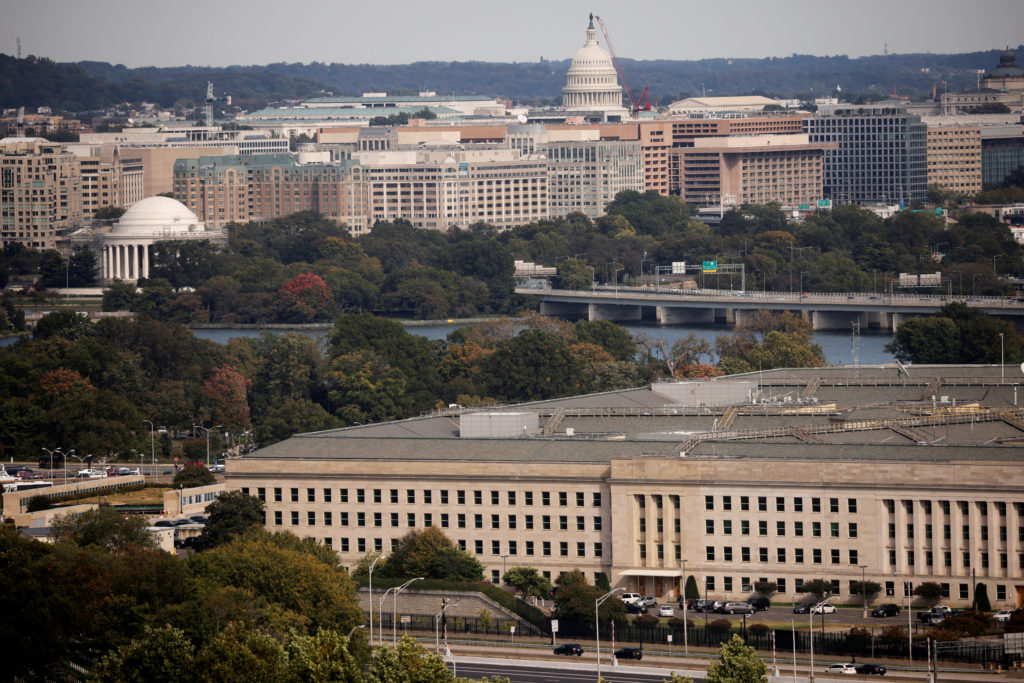
Federal judge finds Pentagon in violation of court order to restore reporters' access
#Pentagon#federal judge#press access#First Amendment#court order#Department of Defense#journalists#transparency
📌 Key Takeaways
A federal judge ruled the Pentagon is violating an order to restore press access.
The case involves a lawsuit by major news organizations over First Amendment rights.
The administration cited operational security as justification for restricting access.
The ruling could set a precedent for press freedom and government transparency cases.
📖 Full Retelling
A federal judge in Washington, D.C., ruled on Thursday that the U.S. Department of Defense is in violation of a court order requiring it to restore press access to the Pentagon, marking a significant legal setback for the Biden administration's efforts to restrict journalists' work. The ruling came from Judge Randolph D. Moss of the U.S. District Court for the District of Columbia, who found that the Pentagon had failed to comply with his previous injunction mandating the reinstatement of reporter credentials and access privileges that had been revoked or limited.
The case stems from a lawsuit filed by a coalition of news organizations, including major outlets like The New York Times and The Washington Post, which argued that the Pentagon's restrictions on press access violated First Amendment rights and hindered the public's ability to receive information about national security and military operations. The administration had defended its actions as necessary for operational security and to manage the flow of information, particularly in light of recent geopolitical tensions and classified leaks. However, Judge Moss's ruling emphasized that the government's justifications were insufficient to override the constitutional protections afforded to the press.
This decision underscores the ongoing tension between government transparency and national security concerns, particularly in an era where information control has become increasingly politicized. Legal experts note that the ruling could set a precedent for future cases involving press freedom and government accountability, potentially limiting the executive branch's ability to unilaterally restrict media access without robust justification. The Pentagon now faces potential sanctions or further court mandates if it fails to promptly comply, raising questions about how the Defense Department will balance its security protocols with its obligations to the First Amendment.
🏷️ Themes
Press Freedom, Government Accountability, Legal Precedent
1791 amendment limiting government restriction of civil liberties
The First Amendment (Amendment I) to the United States Constitution prevents Congress from making laws respecting an establishment of religion; prohibiting the free exercise of religion; or abridging the freedom of speech, the freedom of the press, the freedom of assembly, or the right to petition t...
In geometry, a pentagon (from Greek πέντε (pente) 'five' and γωνία (gonia) 'angle') is any five-sided polygon or 5-gon. The sum of the internal angles in a simple pentagon is 540°.
A pentagon may be simple or self-intersecting.
The United States Department of Defense (DoD), also referred to as the Department of War (DOW), is an executive department of the U.S. federal government charged with coordinating and supervising the U.S. Armed Forces—the Army, Navy, Marines, Air Force, Space Force, and, for some purposes, the Coast...
A federal judge on Thursday ruled that the Defense Department is violating his earlier order to restore access to the Pentagon for reporters, a setback in the administration's efforts to impede the work of journalists.