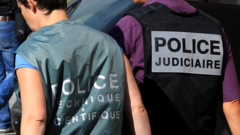
A French murder trial is stalled because DNA on the murder weapon belongs to identical twins.
Standard forensic testing cannot distinguish between monozygotic twins due to their identical genetic sequences.
The legal system requires specific identification of the perpetrator, making it difficult to prosecute either brother without further proof.
Advanced epigenetic testing may be the only scientific way to resolve the case, though it is not yet standard procedure.
📖 Full Retelling
French prosecutors and judicial authorities in Marseille are currently facing a significant legal deadlock in an ongoing murder trial after forensic investigators discovered identical DNA on a recovered weapon belonging to a pair of monozygotic twin brothers. The complication arose during the investigation into a fatal stabbing that occurred in the southern French city, where police identified the two siblings as the primary suspects but found it biologically impossible to distinguish which brother committed the physical act of violence. Because identical twins share the same genetic code, standard profiling techniques have failed to provide the definitive evidence required to charge one individual over the other for the crime.
The case has highlighted a rare but profound vulnerability in the modern criminal justice system, which relies heavily on DNA as the 'gold standard' for identification. While law enforcement successfully recovered the murder weapon and extracted high-quality genetic samples, the laboratory results yielded a 100% match for both men. This genetic indistinguishability has created a paradox for the prosecution, as French law requires the specific identification of a perpetrator to secure a conviction, and charging both men for a single-handed act could lead to a catastrophic miscarriage of justice.
Legal experts suggest that the only way to break the stalemate is through 'ultra-deep sequencing' or epigenetic testing, which looks for chemical modifications on the DNA caused by environmental factors rather than the sequence itself. However, such testing is prohibitively expensive and not yet routine in French criminal laboratories. Without a confession, eyewitness testimony that can distinguish between the two, or advanced forensic breakthroughs, the court faces the possibility of having to release both suspects, as the principle of 'reasonable doubt' protects individuals from being convicted when forensic evidence is shared equally between two potential culprits.
🐦 Character Reactions (Tweets)
DNA Detective
When your alibi is 'my evil twin did it' and the jury can't tell the difference. #TwinTrouble #DNADilemma
Legal Eagle
Prosecutor: 'We have DNA evidence!' Judge: 'So do we... and it's the same guy. Twice.' #JusticeSystemFail
Science Nerd
When your DNA is so identical, even the crime scene can't pick a side. #TwinDilemma #ForensicFail
Crime Buff
The only time 'I plead the fifth' isn't enough. #TwinDefense #LegalLimbo
💬 Character Dialogue
character_1:Ah, the classic case of identical twins and a murder weapon. How delightfully predictable. I suppose this is what happens when you rely on biology instead of my superior cake-based justice system.
character_2:Oh no, this is terrible! The power of the Moon can't even distinguish between them. How will justice prevail in the name of the Moon?
character_3:Twin trouble. How original. Maybe they should just flip a coin and call it a day.
character_1:And here I thought my test subjects were the only ones who struggled with basic identification. At least they have the excuse of being turned into a pile of goo.
character_2:We need a miracle! Maybe the Moon will shine a light on the truth. Or at least give us a clue!
🏷️ Themes
Criminal Justice, Forensics, Legal Ethics
📚 Related People & Topics
Law enforcement in France
# Law Enforcement in France
Law enforcement in the French Republic is structured through a centralized national framework, supplemented by increasingly significant local components.
## National Police Forces
The state maintains two primary national law enforcement agencies, each with distinct juri...
Technique used to identify individuals via DNA characteristics
DNA profiling (also called DNA fingerprinting and genetic fingerprinting) is the process of determining an individual's deoxyribonucleic acid (DNA) characteristics. DNA analysis intended to identify a species, rather than an individual, is called DNA barcoding.
DNA profiling is a forensic technique ...
# Marseille
**Marseille** (Provençal Occitan: *Marselha*) is the second-most populous city in France and a major Mediterranean port located in the southern part of the country. It serves as the prefecture of the **Bouches-du-Rhône** department and the capital of the **Provence-Alpes-Côte d'Azur** r...