
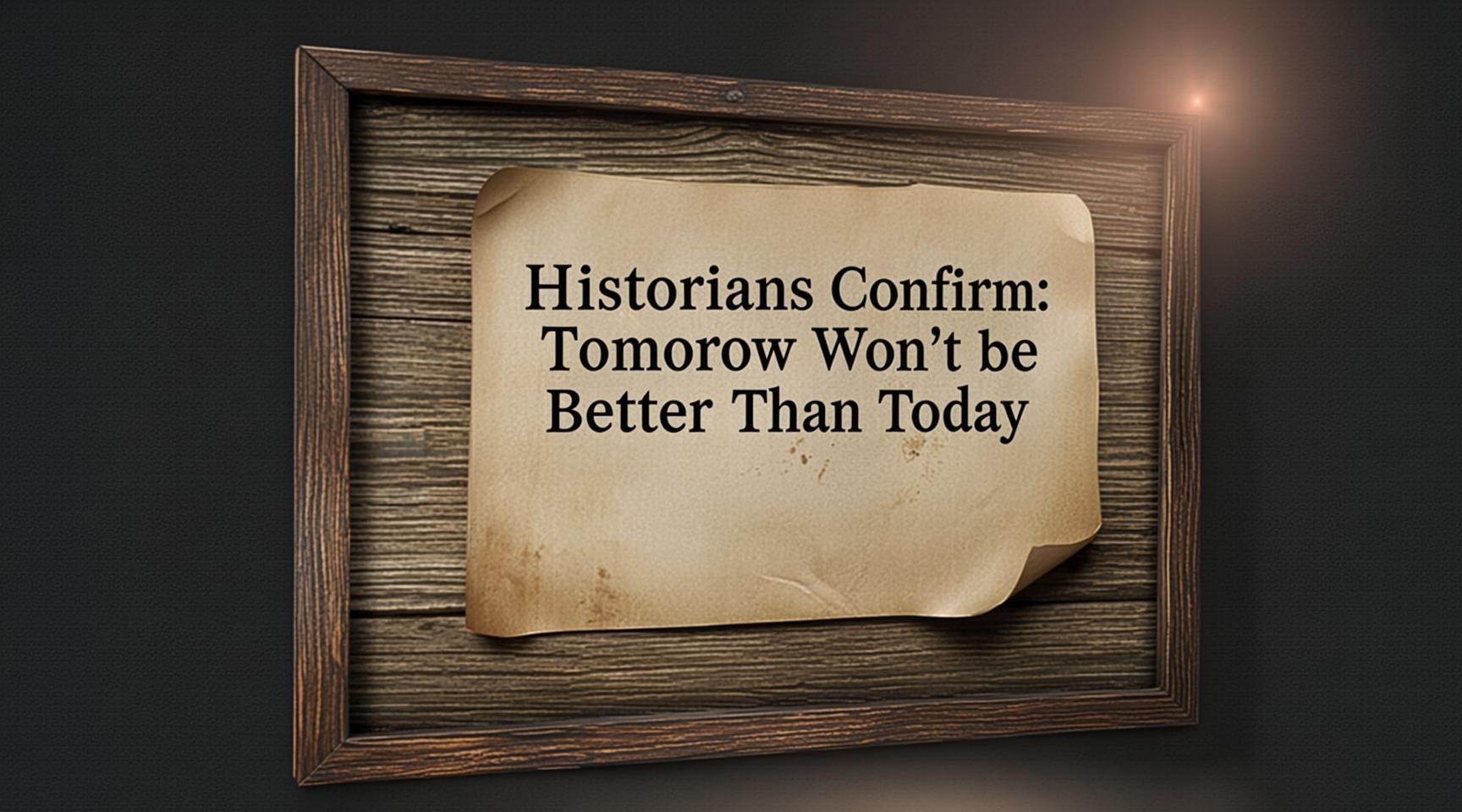
Historians Confirm: Tomorrow Won’t Be Better Than Today
#Historians #Hope #Progress #Berlin 1945 #Delusion #World War II #Human psychology #Cognitive bias
📌 Key Takeaways
- Historians challenge the assumption of inevitable human progress
- Hope can deteriorate into dangerous delusion during crises
- Even in dire situations like 1945 Berlin, people clung to false hopes
- This psychological pattern represents a fundamental aspect of human cognition
📖 Full Retelling
🏷️ Themes
Historical perspective, Human psychology, Hope vs. reality
📚 Related People & Topics
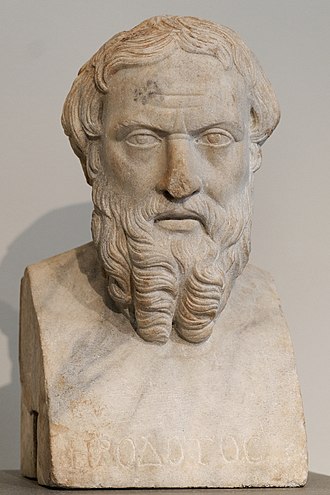
Historian
Scholar who deals with the exploration and presentation of history
A historian is a scholar who studies and writes about the past and is regarded as an authority on it. Historians are concerned with the continuous, methodical narrative and research of past events as relating to the human race; as well as the study of all history in time. Some historians are recogni...

World War II
1939–1945 global conflict
World War II or the Second World War (1 September 1939 – 2 September 1945) was a global conflict between two coalitions: the Allies and the Axis powers. Nearly all of the world's countries participated, with many nations mobilising their resources in pursuit of total war. Tanks and aircraft played m...
Delusion
Fixation of holding false beliefs
A delusion is a fixed belief that is not amenable to change in light of conflicting evidence. As a pathology (delusional disorder), it is distinct from a belief based on false or incomplete information, confabulation, dogma, illusion, hallucination, or some other misleading effects of perception, as...

Progress
Movement towards a desired state
Progress is movement towards a perceived refined, improved, or otherwise desired state. It is central to the philosophy of progressivism, which interprets progress as the set of advancements in technology, science, and social organization – the latter being generally achieved through direct societal...

Hope
Optimistic state of mind
Hope is an optimistic state of mind that is based on an expectation of positive outcomes with respect to events and circumstances in one's own life, or the world at large. As a verb, Merriam-Webster defines hope as "to expect with confidence" or "to cherish a desire with anticipation". Among its opp...
Entity Intersection Graph
No entity connections available yet for this article.
Deep Analysis
Why It Matters
This historical analysis challenges the common human tendency to believe that tomorrow will inevitably be better than today. It provides insight into how even in the most dire circumstances, people cling to hope despite overwhelming evidence to the contrary.
Context & Background
- Refers to the final days of World War II in Europe
- Describes the desperate situation in Berlin in 1945
- Mentions the psychological phenomenon of hoping for miraculous solutions
- Highlights the human capacity for denial in extreme circumstances
What Happens Next
Historians will continue to study this psychological pattern across different historical contexts. The research may inform our understanding of how societies process trauma and maintain hope during crises.
Frequently Asked Questions
That people throughout history have maintained hope for improvement even when objective circumstances suggest otherwise
The final days of World War II when Berlin was under siege by Soviet forces
Fearsome missiles targeting London and hypothetical machines to pull Allied bombers from the sky