
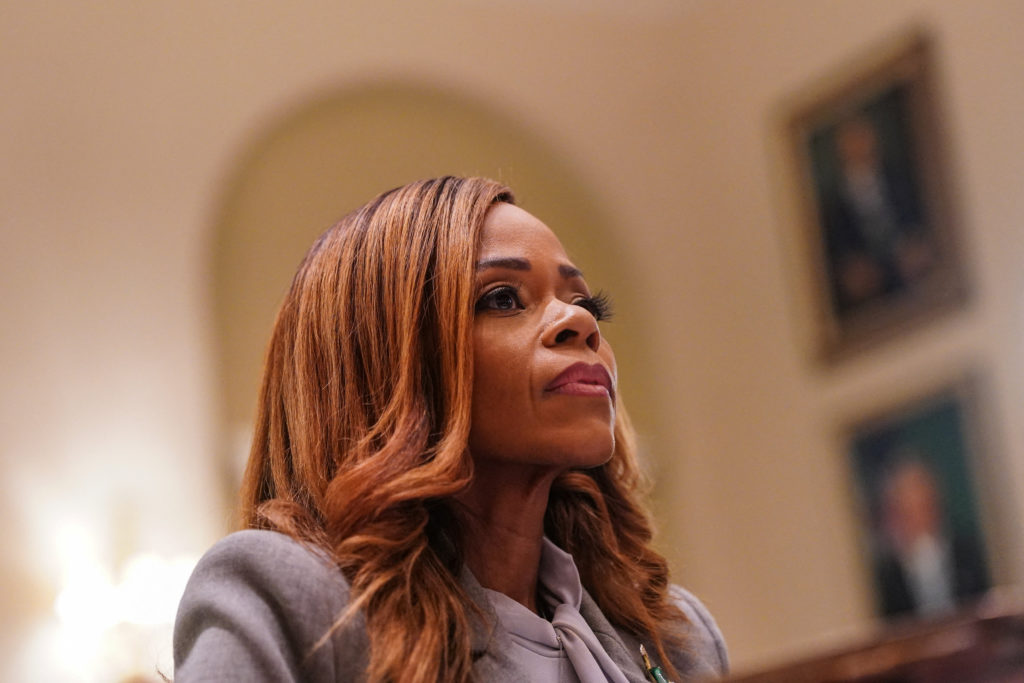
House ethics panel finds Florida Democratic Rep. Cherfilus-McCormick committed 25 violations
📖 Full Retelling
📚 Related People & Topics
Representative democracy
Type of democracy principled on elected representation
Representative democracy, also known as indirect democracy or electoral democracy, is a type of democracy where elected delegates represent a group of people, in contrast to direct democracy. Nearly all modern Western-style democracies function as some type of representative democracy: for example,...

Congress
Formal meeting of representatives
A congress is a formal meeting of the representatives of different countries, constituent states, organizations, trade unions, political parties, or other groups. The term originated in Late Middle English to denote an encounter (meeting of adversaries) during battle, from the Latin congressus.

Florida
U.S. state
Florida ( FLORR-ih-də; Spanish: [floˈɾiða] ) is a state in the Southeastern and South Atlantic regions of the United States. It borders the Gulf of Mexico to the west, Alabama to the northwest, Georgia to the north, the Atlantic Ocean to the east, the Straits of Florida to the south, and The Bahama...
Entity Intersection Graph
No entity connections available yet for this article.
Mentioned Entities
Deep Analysis
Why It Matters
This finding matters because it reveals significant ethical breaches by a sitting member of Congress, undermining public trust in government institutions. It affects Florida's 20th Congressional District constituents who may question their representation, and it impacts the Democratic Party's credibility ahead of elections. The violations also highlight systemic issues in congressional ethics enforcement and could influence legislative accountability debates.
Context & Background
- The House Ethics Committee is a bipartisan panel responsible for investigating alleged misconduct by House members
- Rep. Sheila Cherfilus-McCormick won a 2022 special election to replace the late Rep. Alcee Hastings
- Previous congressional ethics cases have resulted in sanctions ranging from reprimands to expulsion, though expulsion is rare
- The Office of Congressional Ethics (OCE) typically conducts initial reviews before the House Ethics Committee takes up cases
- Ethics violations in Congress often involve campaign finance, misuse of official resources, or failure to properly disclose financial interests
What Happens Next
The House Ethics Committee will likely recommend specific sanctions to the full House of Representatives for a vote. Possible actions include censure, fines, or removal from committee assignments. The timeline depends on House leadership scheduling, but decisions typically occur within weeks of committee findings. Cherfilus-McCormick may appeal or negotiate settlements before final House action.
Frequently Asked Questions
While the specific violations aren't detailed in this summary, typical congressional ethics violations include improper campaign finance practices, misuse of official resources for personal gain, failure to disclose financial interests, or violations of gift rules. The high number (25) suggests multiple categories of misconduct.
Immediate effects may include loss of committee assignments or restrictions on House floor privileges. If the House votes for censure or stronger penalties, she could face reduced influence in legislative matters. However, she remains the elected representative unless expelled, which requires a two-thirds House vote.
Removal (expulsion) is possible but historically rare, requiring a two-thirds House vote. More likely outcomes include censure, fines, or reprimand. Voters ultimately decide her political future in the next election, where ethics findings may become a major campaign issue.
She can appeal through House Ethics Committee procedures or request reconsideration. If the full House votes on sanctions, she can speak in her defense during floor debate. Legal challenges in federal courts are generally not permitted for internal congressional disciplinary matters.
Twenty-five violations is a substantial number compared to recent cases. Most ethics investigations involve fewer than 10 alleged violations. The volume suggests either widespread misconduct or multiple related infractions across different ethical categories over an extended period.