
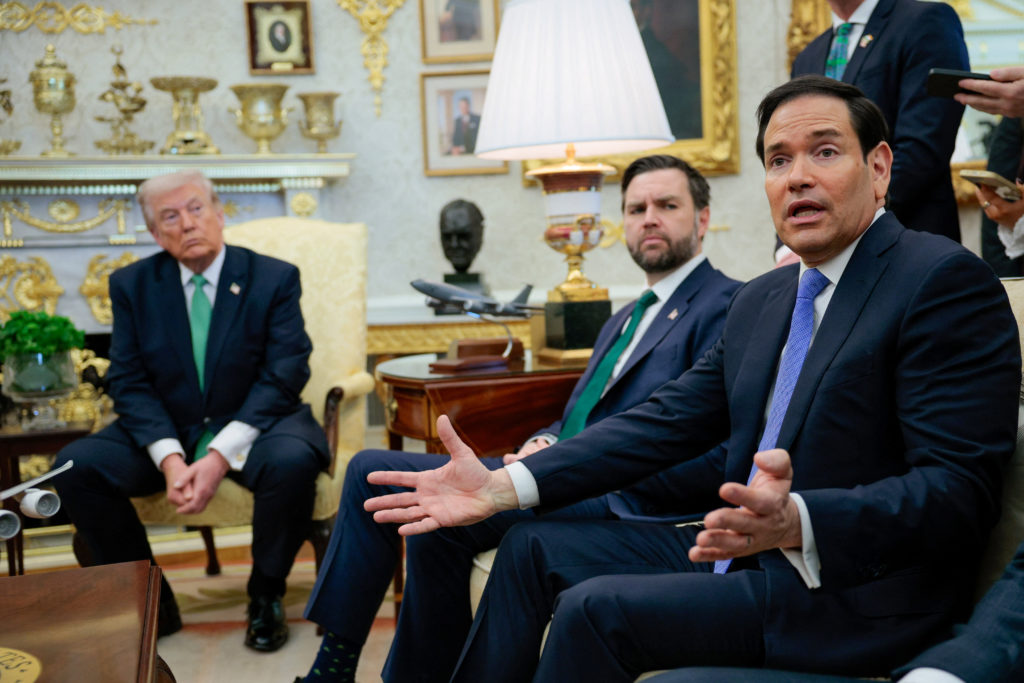
How Rubio's and Vance's differing stances on Iran war point to challenges ahead of 2028 election
📖 Full Retelling
📚 Related People & Topics
Republican Party
Topics referred to by the same term
Republican Party is a name used by many political parties around the world, a reference to Republicanism, a political ideology.

Iran
Country in West Asia
# Iran **Iran**, officially the **Islamic Republic of Iran** and historically known as **Persia**, is a sovereign country situated in West Asia. It is a major regional power, ranking as the 17th-largest country in the world by both land area and population. Combining a rich historical legacy with a...
Entity Intersection Graph
Connections for Rubio:
Mentioned Entities
Deep Analysis
Why It Matters
This analysis matters because it reveals emerging fault lines within the Republican Party's foreign policy establishment that could shape the 2028 presidential primary. Marco Rubio's hawkish stance versus J.D. Vance's more restrained approach represents a broader debate about America's role in the Middle East that affects military families, defense contractors, and global energy markets. These divisions will influence how the GOP positions itself on national security issues, potentially impacting U.S. alliances and military commitments abroad. The outcome of this internal debate could determine whether the party embraces traditional interventionism or continues shifting toward the 'America First' foreign policy that gained prominence under Trump.
Context & Background
- Marco Rubio has consistently advocated for a strong U.S. military presence in the Middle East since his 2016 presidential campaign, positioning himself as a traditional Republican hawk
- J.D. Vance represents the newer 'America First' wing of the GOP that questions prolonged military engagements abroad, reflecting a shift that began during Trump's presidency
- The U.S. has maintained tense relations with Iran since the 1979 Islamic Revolution, with recent conflicts including the 2020 assassination of Iranian General Qasem Soleimani and ongoing nuclear negotiations
- Republican foreign policy debates have intensified since the Iraq and Afghanistan wars, with growing skepticism about nation-building and prolonged military commitments
- Both Rubio and Vance are considered potential 2028 presidential contenders, making their policy differences particularly significant for the party's future direction
What Happens Next
The Republican primary debates leading up to 2028 will likely feature heated exchanges between interventionist and restraint-oriented candidates on Middle East policy. Expect both Rubio and Vance to refine their positions through speeches, op-eds, and committee work in Congress over the next three years. The 2024 election outcome will significantly influence which foreign policy approach gains momentum within the GOP, with a Trump victory likely boosting Vance's 'America First' perspective. Key developments to watch include congressional votes on military authorization, responses to future Iranian provocations, and the candidates' performance in early primary states like Iowa and New Hampshire.
Frequently Asked Questions
Rubio advocates for maintaining strong military deterrence and potential offensive action against Iranian threats, while Vance favors diplomatic engagement and avoiding new military entanglements. Rubio supports maintaining sanctions pressure and military partnerships with regional allies, whereas Vance questions the value of permanent Middle East deployments and prioritizes domestic concerns over foreign interventions.
This debate could create a major dividing line between establishment and populist candidates, potentially splitting the party's donor base and voter coalition. Candidates will need to navigate between traditional Republican hawks and the growing 'America First' movement that gained strength during the Trump presidency, making foreign policy a central rather than peripheral primary issue.
Rubio's stance reflects post-9/11 Republican orthodoxy that emphasized projecting American power to combat terrorism and protect allies. Vance's position builds on growing war fatigue after Iraq and Afghanistan, combined with Trump's successful challenge to neoconservative foreign policy assumptions during his 2016 campaign and presidency.
A Rubio-influenced approach would likely mean continued maximum pressure through sanctions and military posturing, potentially increasing confrontation risks. A Vance-influenced policy might involve more direct diplomacy and reduced military presence in the region, possibly leading to renewed nuclear negotiations but risking perceptions of weakened deterrence.
Rubio's hawkish stance appeals to traditional national security Republicans, defense industry interests, and pro-Israel advocates within the party. Vance's restraint-oriented approach resonates with populist voters skeptical of foreign wars, libertarian-leaning Republicans concerned about military spending, and some evangelical Christians focused on domestic priorities.