Supreme Court struck down major portion of Trump's tariff agenda
Apple has paid approximately $3.3 billion in tariffs since Trump initiated them
Decision could lower Apple's production costs and reduce pressure to move manufacturing out of China
Trump announced plans for a new 10% 'global tariff' shortly after the ruling
📖 Full Retelling
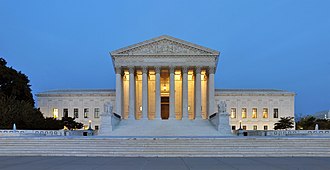
The Supreme Court delivered a major rebuke to President Donald Trump's economic agenda on Friday by striking down a significant portion of his far-reaching tariff policy, a decision that will directly impact Apple Inc.'s mounting $3.3 billion tariff bill and potentially reshape the tech giant's global supply chain strategy. The ruling came as Apple's shares rose approximately 1% in response to news that the company's quarterly tariff costs of about $1 billion might soon decrease. Since Trump initiated the tariffs last year, Apple has faced substantial import duties on products and components manufactured overseas, particularly from China and other Asian partners like Vietnam and India. The court's 6-3 decision declared that tariffs unilaterally imposed by Trump were illegal, potentially opening the door for more than $175 billion in refunds to importers, though Trump indicated he expects multi-year litigation over repayment. The ruling effectively eliminates Trump's 47% tariff rate on Chinese-made goods and frees Apple to produce more U.S.-bound products in China rather than diverting production to India and Vietnam where it had been shifting to avoid higher tariffs. Despite the positive financial implications, Apple has not indicated whether it will seek to recover the tariffs it has already paid, choosing in the past to absorb costs rather than risk customer anger or political backlash from the administration. Hours after the Supreme Court ruling, Trump announced plans to sign an executive order imposing a new 10% 'global tariff' under Section 122 of the Trade Act of 1974, demonstrating that trade tensions will continue to shape the business landscape for companies like Apple that rely on complex international supply chains.
🏷️ Themes
Trade Policy, Corporate Finance, International Manufacturing
In most legal jurisdictions, a supreme court, also known as a court of last resort, apex court, high (or final) court of appeal, and court of final appeal, is the highest court within the hierarchy of courts. Broadly speaking, the decisions of a supreme court are binding on all other courts in a nat...
Economic conflict using tariffs or other trade barriers
# Trade War
A **trade war** is an economic conflict typically resulting from extreme protectionism. It occurs when sovereign states implement or escalate tariffs and other trade barriers against one another as a component of their commercial policies. These actions are generally retaliatory, functi...
A tariff or import tax is a duty imposed by a national government, customs territory, or supranational union on imports of goods and is paid by the importer. Exceptionally, an export tax may be levied on exports of goods or raw materials and is paid by the exporter. Besides being a source of revenue...
An apple is the round, edible fruit of an apple tree (Malus spp.). Fruit trees of the orchard or domestic apple (Malus domestica), the most widely grown in the genus, are cultivated worldwide. The tree originated in Central Asia, where its wild ancestor, Malus sieversii, is still found.
President of the United States (2017–2021; since 2025)
Donald John Trump (born June 14, 1946) is an American politician, media personality, and businessman who is the 47th president of the United States. A member of the Republican Party, he served as the 45th president from 2017 to 2021.
Born into a wealthy New York City family, Trump graduated from the...
In this article AAPL Follow your favorite stocks CREATE FREE ACCOUNT Tim Cook, chief executive officer of Apple Inc., during the 60th presidential inauguration in the rotunda of the US Capitol in Washington, DC, US, on Monday, Jan. 20, 2025. Bloomberg | Getty Images Apple's tariff bill has racked up about $1 billion per quarter, but that number should start shrinking following the Supreme Court decision on tariffs. The Supreme Court on Friday struck down a large chunk of President Donald Trump 's far-reaching tariff agenda, delivering a major rebuke of the president's key economic policy. Apple has paid about $3.3 billion in tariffs since Trump initiated them last year. The iPhone maker's shares rose about 1% on Friday. Friday's decision means Apple could start to see lower production costs and keep more of its margins. The company could also face less pressure to move its production away from China and simplify its supply chain. Apple declined to comment. The large tariff costs stem from U.S. import duties on products and components manufactured overseas — especially from China and other Asian partners, like Vietnam and India. When laying out the plan to handle tariffs in May, CEO Tim Cook said Apple is sourcing half of its iPhones for the U.S. from India and most of its other U.S.-bound products like Macs, AirPods and watches from Vietnam, where tariffs were lower than China's at the time. Friday's decision kills Trump's tariffs on China-made goods, which were at a 47% rate as of December . It also frees Apple up to produce more U.S.-bound products in China, where most of its products to non-U.S. countries have been sourced, instead of diverting to India and Vietnam. On earnings calls, Cook has emphasized that Apple is largely absorbing tariff costs to avoid sudden price jumps for customers. watch now VIDEO 4:28 04:28 Tariff ruling won't have direct impact on semiconductors, says Bernstein's Stacy Rasgon Power Lunch Friday's ruling means the U.S. government could ...