
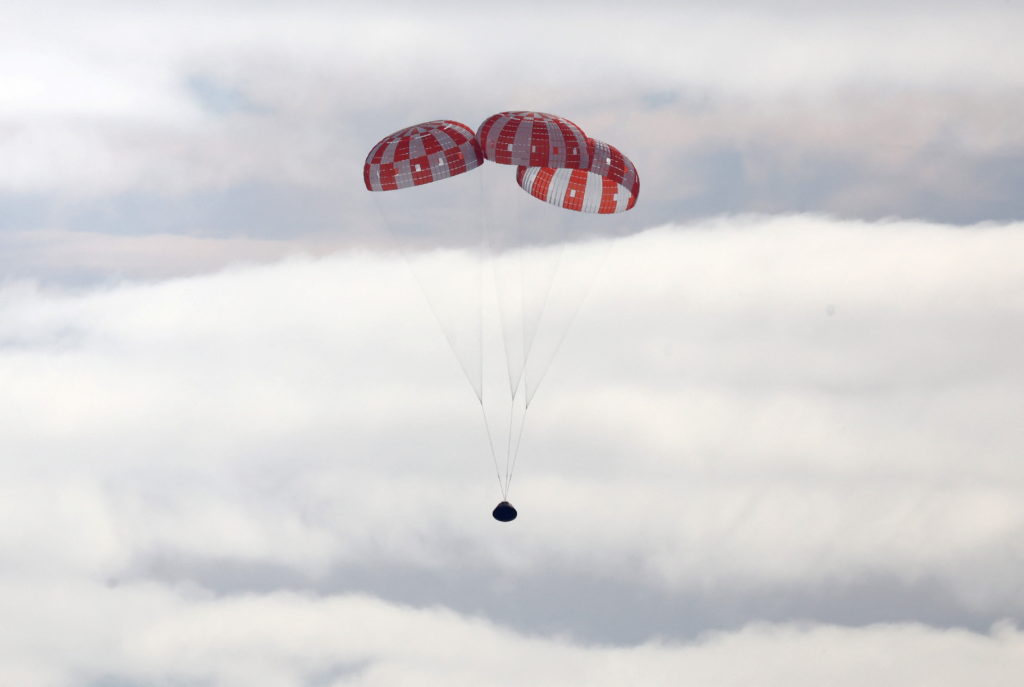
How will NASA get the Artemis II crew safely back on Earth? Here's the science behind splashdown
#NASA #Artemis II #splashdown #Orion spacecraft #reentry #astronaut recovery #Pacific Ocean #heat shield
📌 Key Takeaways
- Artemis II crew will return via controlled Pacific Ocean splashdown in September 2025
- Orion spacecraft undergoes extreme reentry at 25,000 mph with 5,000°F heat shield protection
- Parachute system slows capsule from supersonic speeds to 20 mph before ocean impact
- NASA/DOD recovery teams will retrieve astronauts using naval vessels and helicopters
- Procedure builds on decades of NASA splashdown experience from Apollo to Crew Dragon
📖 Full Retelling
🏷️ Themes
Space Exploration, Aerospace Engineering, Mission Safety
📚 Related People & Topics

NASA
American space and aeronautics agency
The National Aeronautics and Space Administration (NASA ) is an independent agency of the U.S. federal government responsible for the United States' civil space program and for research in aeronautics and space exploration. Headquartered in Washington, D.C., NASA operates ten field centers across th...

Artemis II
Artemis program's second lunar flight
Artemis II is a planned lunar spaceflight mission under the Artemis program, led by NASA. It is intended to be the second flight of the Space Launch System (SLS), and the first crewed mission of the Orion spacecraft. It is the first crewed mission around the Moon, and beyond low Earth orbit, since A...

Pacific Ocean
Largest ocean
The Pacific Ocean is the largest and deepest of Earth's five oceanic divisions. It stretches from the Arctic Ocean in the north to the Southern Ocean, or, depending on the definition, to Antarctica in the south, and is bounded by the continents of Asia and Australia in the west and the Americas in t...

Orion (spacecraft)
American crewed spacecraft for the Artemis program
Orion (Orion Multi-Purpose Crew Vehicle or Orion MPCV) is a partially reusable crewed spacecraft used in NASA's Artemis program. The spacecraft consists of a Crew Module (CM) space capsule designed by Lockheed Martin that is paired with a European Service Module (ESM) manufactured by Airbus Defence ...
Entity Intersection Graph
Connections for NASA: