
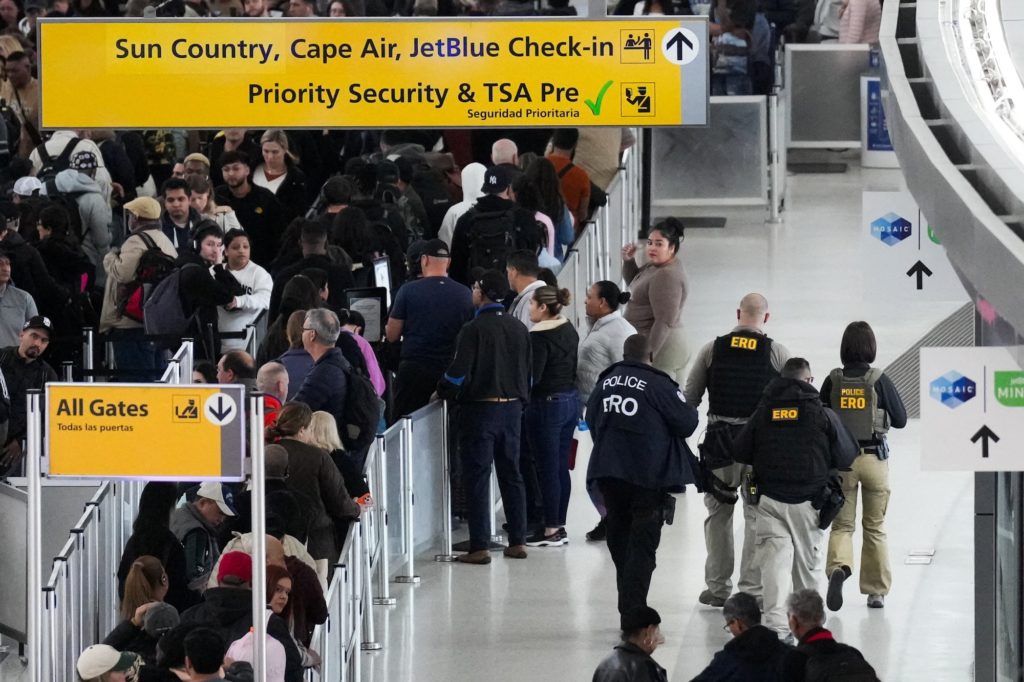
ICE agents deploy to major U.S. airports as TSA faces shutdown shortages
📖 Full Retelling
📚 Related People & Topics

Transportation Security Administration
United States federal government agency
The Transportation Security Administration (TSA) is an agency of the United States Department of Homeland Security (DHS) that has authority over the security of transportation systems within and connecting to the United States. It was created as a response to the September 11 attacks to improve airp...

United States Immigration and Customs Enforcement
US federal law enforcement agency
The United States Immigration and Customs Enforcement (ICE) is a federal law enforcement agency under the United States Department of Homeland Security. Its stated mission is to conduct criminal investigations, enforce immigration laws, preserve national security, and protect public safety. ICE was ...
Entity Intersection Graph
Connections for Transportation Security Administration:
View full profileMentioned Entities
Deep Analysis
Why It Matters
This deployment matters because it represents an unprecedented use of immigration enforcement personnel for domestic airport security functions, potentially blurring lines between immigration enforcement and transportation security. It affects millions of travelers who may encounter ICE agents during routine airport screenings, raising concerns about civil liberties and racial profiling. The situation also impacts TSA workers who face financial hardship during the shutdown, potentially compromising airport security effectiveness.
Context & Background
- The partial government shutdown began on December 22, 2018, affecting approximately 800,000 federal employees
- TSA agents are considered 'essential personnel' and must work without pay during shutdowns, creating financial strain and morale issues
- ICE (Immigration and Customs Enforcement) typically focuses on immigration enforcement, not airport security screening operations
- Previous government shutdowns have seen TSA call-out rates increase as financial pressures mount on unpaid workers
What Happens Next
Expect increased airport delays and security disruptions as TSA absenteeism grows with each missed paycheck. Congressional negotiations will intensify pressure to resolve the shutdown before major travel disruptions occur. The deployment may face legal challenges regarding ICE's authority to perform TSA functions. If the shutdown continues, more unconventional measures may be implemented to maintain airport operations.
Frequently Asked Questions
ICE agents are being deployed because TSA is experiencing staffing shortages due to the government shutdown, with many agents calling out sick or refusing to work without pay. This represents an emergency measure to maintain minimum security staffing levels at major airports across the country.
While both agencies receive security training, ICE agents typically focus on immigration enforcement rather than passenger screening. They would require additional training on TSA-specific procedures and equipment, potentially creating operational challenges during the transition period.
Travelers may experience longer security lines and different screening procedures. More significantly, they may encounter immigration enforcement officers during routine domestic travel, raising concerns about potential questioning beyond standard security screening protocols.
The legality is unclear and may face legal challenges. While the government has broad emergency powers during crises, using immigration enforcement personnel for domestic airport security represents an unusual application of authority that could be contested in court.
TSA workers are required to work without pay as 'essential personnel.' They will receive back pay once the shutdown ends, but face immediate financial hardship that leads to increased absenteeism and low morale.