
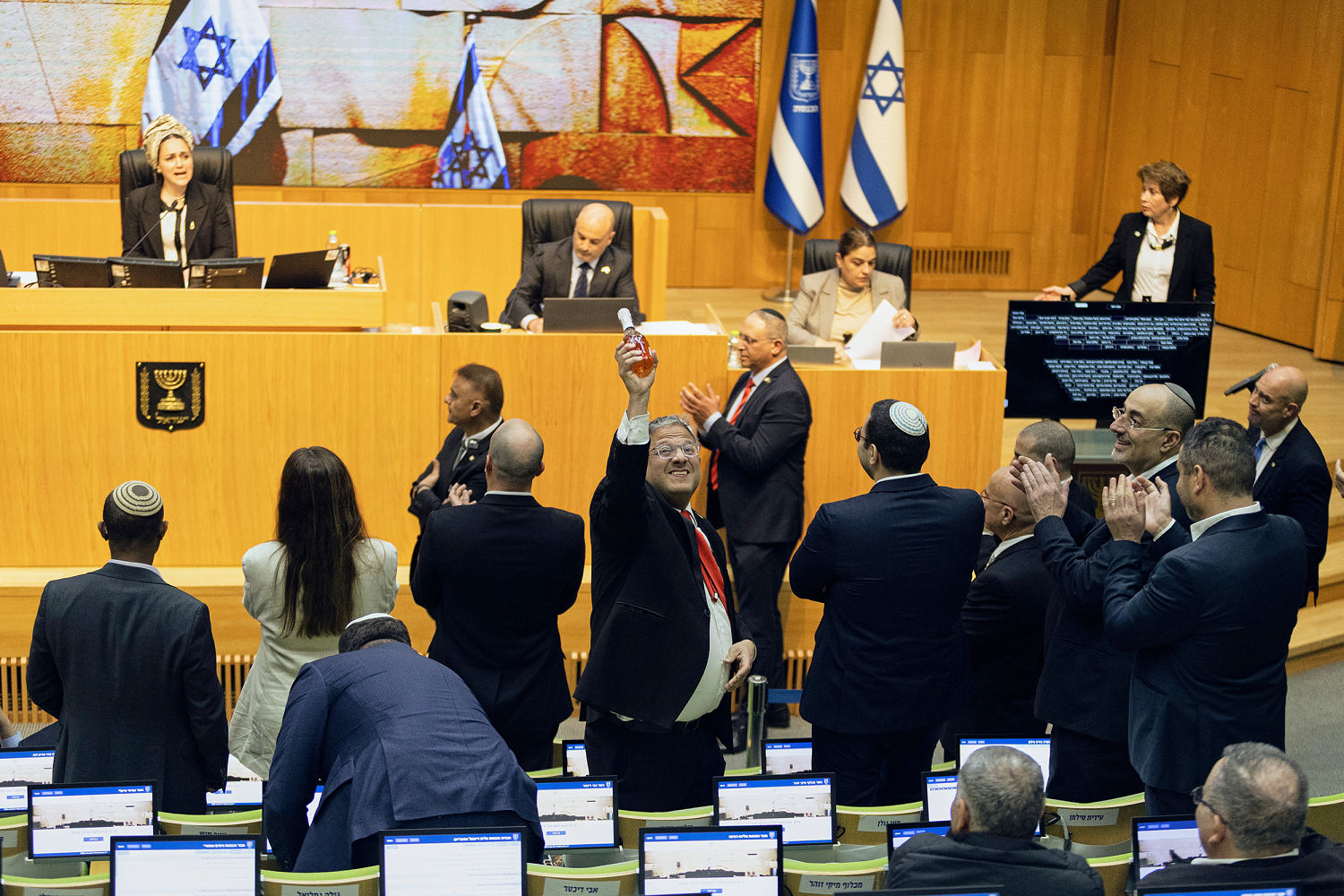
Israeli death penalty law targeting Palestinians sparks global outcry as far right celebrates
📖 Full Retelling
📚 Related People & Topics

Palestinians
Arab ethnonational group of the Levant
Palestinians (Arabic: الفلسطينيون, romanized: al-Filasṭīniyyūn) are an Arab ethnonational group native to the Levantine region of Palestine. They represent a highly homogeneous community who share a cultural and ethnic identity, speak Palestinian Arabic and share close religious, linguistic, and cul...

Israel
Country in West Asia
Israel, officially the State of Israel, is a country in the Southern Levant region of West Asia. It is bordered by Lebanon to the north, Syria to the northeast, Jordan to the east, and Egypt to the southwest. Israel occupies the West Bank and the Gaza Strip of the Palestinian territories, as well as...
Entity Intersection Graph
Connections for Palestinians:
Mentioned Entities
Deep Analysis
Why It Matters
This legislation represents a significant escalation in Israel's judicial approach to Palestinian attacks, potentially deepening the Israeli-Palestinian conflict and raising serious human rights concerns. It directly affects Palestinian prisoners and their families while creating diplomatic tensions between Israel and international allies who oppose capital punishment. The law's passage signals the growing influence of far-right factions in Israel's government, which could impact future policy decisions regarding occupied territories and conflict resolution efforts.
Context & Background
- Israel has not carried out an execution since 1962, when Nazi war criminal Adolf Eichmann was hanged, making this legislation a dramatic departure from decades of practice.
- The death penalty has long been a contentious issue in Israel, with previous attempts to introduce it failing to pass through parliament.
- International human rights organizations have consistently criticized Israel's treatment of Palestinian prisoners, with approximately 4,700 Palestinians currently held in Israeli prisons according to recent estimates.
- The law specifically targets 'terrorist' attacks resulting in Israeli deaths, reflecting ongoing security tensions that have persisted since the October 7 Hamas attacks that killed approximately 1,200 Israelis.
What Happens Next
International condemnation is likely to intensify, with potential diplomatic repercussions from European allies and human rights organizations. Legal challenges are expected both within Israel's court system and potentially at international tribunals. The law's implementation will face practical hurdles as Israeli courts have historically been reluctant to impose death sentences, and the first test cases could emerge within months.
Frequently Asked Questions
The law applies to Palestinians convicted of 'terrorist' attacks that result in Israeli deaths, with provisions for military courts to impose capital punishment. It specifically targets attacks motivated by 'hostility toward Israel' rather than ordinary criminal homicides.
Human rights organizations argue the law violates international humanitarian law, particularly the Fourth Geneva Convention, which prohibits imposing death sentences in occupied territories except for grave breaches. Israel maintains its military court system operates within legal parameters.
The European Union, United Nations human rights officials, and multiple Western governments have expressed concern, warning it could exacerbate tensions. Palestinian authorities have condemned it as 'racist' while far-right Israeli ministers celebrated it as a deterrent measure.
Yes, Israel's Supreme Court can review the legislation's constitutionality, though previous death penalty proposals have failed politically before reaching judicial review. Human rights organizations are already preparing legal challenges.
The law further complicates already stalled peace efforts, hardening positions on both sides. Palestinian officials view it as collective punishment that undermines trust, while Israeli supporters argue it addresses security concerns that must precede negotiations.