
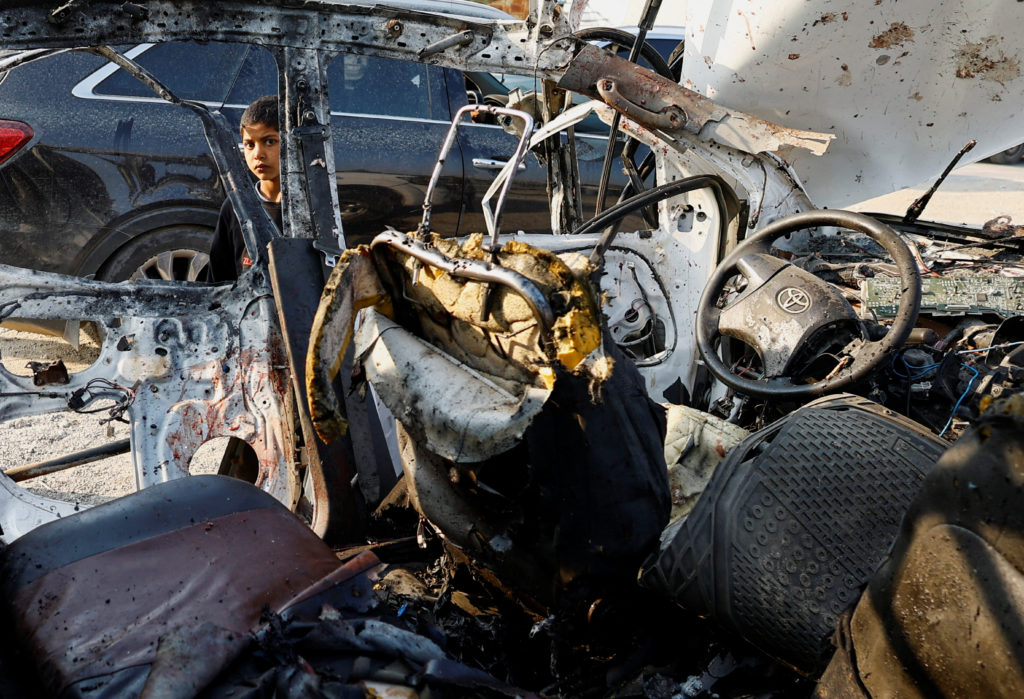
Israeli strikes in Gaza killed 12 people, including 2 children and a pregnant woman, hospital officials say
#Israeli strikes #Gaza #civilian deaths #children #pregnant woman #hospital officials #airstrikes
📌 Key Takeaways
- Israeli airstrikes in Gaza resulted in 12 fatalities, including two children and a pregnant woman, according to hospital officials.
- The attack highlights the ongoing conflict and civilian casualties in the region.
- Hospital officials are the source of the casualty information, indicating local medical authorities are reporting the incident.
- The inclusion of children and a pregnant woman among the dead underscores the impact on vulnerable populations.
📖 Full Retelling
🏷️ Themes
Gaza conflict, Civilian casualties
📚 Related People & Topics

Israeli Air Force
Aerial and space service branch of the Israel Defense Forces
The Israeli Air Force (IAF; Hebrew: זְרוֹעַ הָאֲוִיר וְהֶחָלָל, romanized: Zroa HaAvir VeHahalal, lit. 'Air and Space Arm', commonly known as חֵיל הָאֲוִיר, Kheil HaAvir, "Air Corps") operates as the aerial and space warfare branch of the Israel Defense Forces (IDF). It was founded on May 28, 1948,...
Entity Intersection Graph
Connections for Israeli Air Force:
View full profileMentioned Entities
Deep Analysis
Why It Matters
This news matters because it represents ongoing civilian casualties in the Israel-Gaza conflict, highlighting the human cost of military operations. It affects Palestinian families in Gaza who face displacement and loss, Israeli citizens concerned about security and international responses, and global observers monitoring humanitarian law violations. The deaths of children and a pregnant woman raise urgent questions about proportionality and civilian protection in conflict zones, potentially influencing international diplomatic pressure and aid responses.
Context & Background
- The Israel-Gaza conflict has involved periodic escalations since Hamas took control of Gaza in 2007, with major military operations occurring in 2008-2009, 2012, 2014, and 2021
- Gaza has been under an Israeli-Egyptian blockade since 2007, restricting movement of people and goods, contributing to humanitarian crises
- International humanitarian law requires distinguishing between combatants and civilians, with proportionality principles limiting civilian harm during military operations
- Previous conflicts have resulted in thousands of Palestinian and Israeli civilian deaths, with UN investigations documenting potential war crimes by both sides
What Happens Next
Palestinian authorities will likely request emergency UN Security Council meetings while Israel may justify strikes as targeting militant infrastructure. Humanitarian organizations will assess damage and medical needs, potentially calling for ceasefires. The incident may influence ongoing mediation efforts by Egypt, Qatar, or the United States, with possible increased international condemnation affecting diplomatic relations.
Frequently Asked Questions
Israel states it targets militant groups like Hamas and Islamic Jihad in response to rocket attacks or to prevent future operations. The military claims strikes aim at weapons facilities, tunnels, and command centers, though civilian areas are sometimes affected due to Gaza's dense population.
Casualty figures typically come from Gaza's Health Ministry (Hamas-run) and are generally considered reliable by UN agencies, though Israel sometimes disputes specific cases. International organizations like the UN and Red Cross may conduct independent verification when access permits.
The Geneva Conventions require distinguishing between combatants and civilians, prohibiting direct attacks on civilians. The principle of proportionality forbids attacks expected to cause excessive civilian harm relative to military advantage. Medical facilities and personnel have special protected status.
Civilian casualties typically harden positions, making negotiations more difficult. They may increase Palestinian public support for armed resistance while strengthening Israeli security arguments. However, severe incidents sometimes create urgency for mediators to prevent further escalation.