
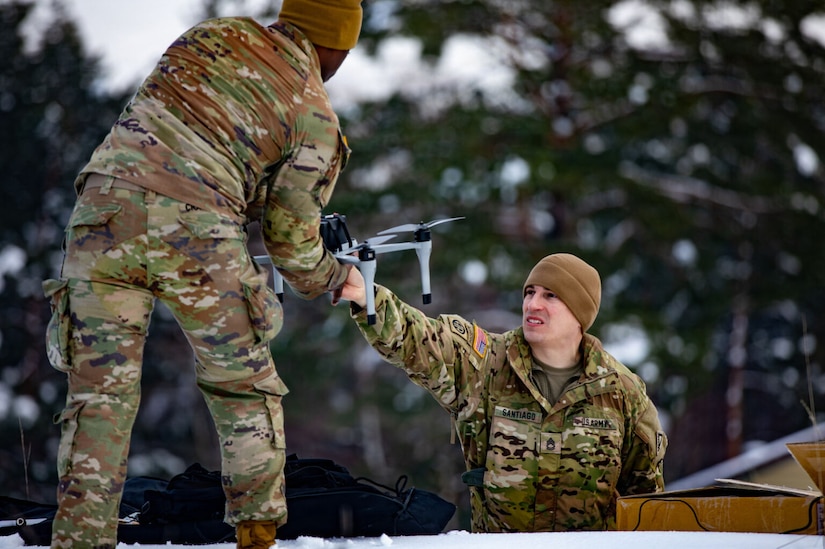
Joint Interagency Task Force Marks 6 Months With Accelerated Delivery of Counter-UAS Capabilities
#Joint Interagency Task Force 401 #Counter-UAS capabilities #Unmanned aircraft systems #Defense technology #Rapid deployment #Military innovation #Drone defense #Joint forces
📌 Key Takeaways
- Joint Interagency Task Force 401 has achieved significant progress in 6 months
- Counter-UAS capabilities are being delivered to joint forces at an accelerated pace
- The task force uses innovative approaches to streamline technology development
- Several counter-UAS systems have already been deployed to operational units
📖 Full Retelling
🏷️ Themes
Defense innovation, Rapid acquisition, Counter-drone technology
📚 Related People & Topics

Military technology
Application of technology for use in warfare
Military technology is the application of technology for use in warfare. It comprises the kinds of technology that are distinctly military in nature and not civilian in application, usually because they lack useful or legal civilian applications, or are dangerous to use without appropriate military ...
Rapid reaction force
Military or police unit capable of quickly responding to emergencies
A rapid reaction force / rapid response force (RRF), quick reaction force / quick response force (QRF), immediate reaction force (IRF), rapid deployment force (RDF), or quick maneuver force (QMF) is a military unit capable of responding to emergencies in a very short time frame.
Entity Intersection Graph
Connections for Military technology:
Mentioned Entities
Deep Analysis
Why It Matters
The proliferation of hostile drones poses an immediate and evolving threat to military personnel and critical infrastructure globally, making the rapid deployment of countermeasures a top priority for national security. JITF 401's success in accelerating the acquisition process signifies a crucial shift away from traditional, slow-moving procurement cycles toward agile methodologies that can keep pace with modern technological warfare. This development directly benefits warfighters by ensuring they receive state-of-the-art defensive tools faster, ultimately saving lives and enhancing operational effectiveness in contested environments.
Context & Background
- Unmanned aircraft systems (UAS) have evolved from niche surveillance tools into primary weapons platforms in recent conflicts, such as in Ukraine and the Middle East, highlighting a critical gap in air defense.
- Traditional defense acquisition cycles in the U.S. often take years to field new equipment, a timeline that is too slow to counter rapidly evolving commercial drone technology.
- JITF 401 was established specifically to bridge this gap by utilizing authorities that allow for rapid prototyping and fielding, bypassing some standard bureaucratic hurdles.
- The threat landscape includes not only military-grade drones but also modified commercial off-the-shelf drones, which are inexpensive and widely available to non-state actors.
What Happens Next
In the coming months, JITF 401 is expected to announce specific contracts and the fielding of new prototype systems to operational units as they exit the testing phase. The task force will likely expand its collaborative exercises to include more international allies to ensure interoperability of counter-drone systems across joint and coalition forces. Furthermore, as drone threats evolve toward AI-enabled swarms, the task force's focus will likely shift toward developing autonomous counter-response technologies.
Frequently Asked Questions
The primary mission of JITF 401 is to accelerate the delivery of counter-unmanned aircraft system (C-UAS) capabilities to joint forces. They aim to streamline the process of identifying, developing, and fielding technologies that can detect and neutralize hostile drones.
Traditional military acquisition is often slow and bureaucratic, taking years to deliver equipment. Drone technology evolves rapidly, meaning that by the time a traditional system is fielded, it may already be obsolete against newer drone threats.
The task force relies on a collaborative ecosystem that includes various U.S. government agencies, private defense contractors, and academic institutions. These partnerships help foster innovation and ensure rigorous testing standards for reliability.
The task force is prioritizing technologies capable of detecting, tracking, and neutralizing unauthorized drones. This includes systems that use rapid prototyping to address the specific challenges of contested environments.