
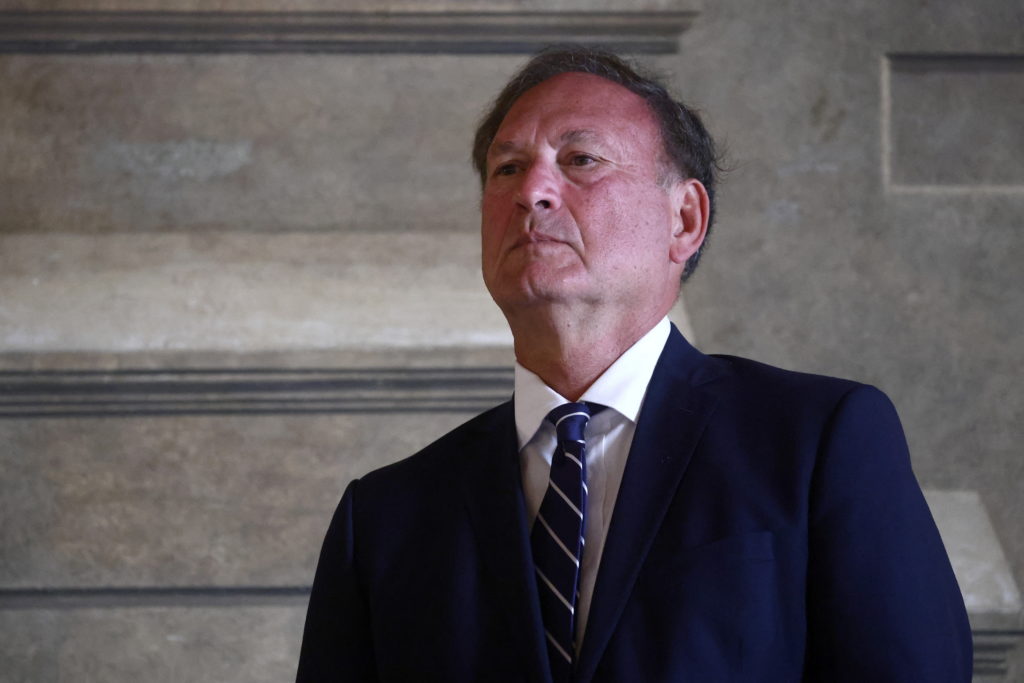
Justice Alito fell ill at a March event and was treated for dehydration, Supreme Court says
📖 Full Retelling
📚 Related People & Topics
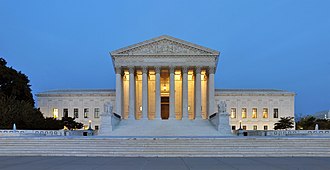
Supreme court
Highest court in a jurisdiction
In most legal jurisdictions, a supreme court, also known as a court of last resort, apex court, high (or final) court of appeal, and court of final appeal, is the highest court within the hierarchy of courts. Broadly speaking, the decisions of a supreme court are binding on all other courts in a nat...

Samuel Alito
US Supreme Court justice since 2006
Samuel Anthony Alito Jr. ( ə-LEE-toh; born April 1, 1950) is an American jurist who serves as an associate justice of the Supreme Court of the United States. He was nominated to the high court by President George W. Bush on October 31, 2005, and has served on it since January 31, 2006.
Entity Intersection Graph
Connections for Supreme court:
Mentioned Entities
Deep Analysis
Why It Matters
This news matters because Justice Samuel Alito is one of nine Supreme Court justices whose health directly impacts the functioning of the nation's highest court. At age 74, any health issue involving a justice raises concerns about judicial continuity and the court's ability to maintain its full bench. The Supreme Court is currently handling numerous high-profile cases, and Alito's absence could potentially delay decisions or create 4-4 splits on critical matters. This affects all Americans who rely on the Supreme Court for final rulings on constitutional issues, as well as the specific litigants in pending cases before the court.
Context & Background
- Justice Samuel Alito, 74, was appointed by President George W. Bush in 2006 and has served on the Supreme Court for 18 years
- The Supreme Court currently has a 6-3 conservative majority, with Alito being one of its most consistently conservative voices
- Supreme Court justices serve lifetime appointments, making their health and longevity significant for the court's ideological balance
- Recent years have seen increased public attention on Supreme Court justices' health following Justice Ruth Bader Ginsburg's death in 2020 and subsequent replacement
- The Supreme Court is currently in its 2023-2024 term with several major cases pending, including those involving presidential immunity and abortion access
What Happens Next
The Supreme Court will continue monitoring Justice Alito's health as he resumes his duties. The court's current term runs through June 2024, with major decisions expected in the coming months. If Alito experiences further health issues requiring extended absence, the court may need to delay rulings or proceed with only eight justices on certain cases. Long-term, this incident may renew discussions about Supreme Court term limits or mandatory retirement ages, though no immediate changes are expected.
Frequently Asked Questions
Justices can take medical leave, but there's no formal mechanism for temporary replacements. If a justice becomes permanently incapacitated, they would need to retire or pass away before a replacement can be nominated. The court would continue operating with eight justices until a replacement is confirmed.
Health issues are not uncommon given the advanced age of many justices. Recent examples include Justice Ruth Bader Ginsburg's multiple cancer battles and Justice Stephen Breyer's retirement at age 83. The court has procedures to accommodate justices' health needs while maintaining operations.
If Justice Alito misses oral arguments or deliberations, it could potentially delay decisions or result in 4-4 ties on closely divided cases. However, dehydration is typically a temporary condition, and the court indicated he was treated and is fine, suggesting minimal disruption to the court's schedule.
The court is hearing major cases including Trump's immunity claim, abortion pill access, social media content moderation, and gun rights. Alito's participation is particularly significant in these ideologically charged cases where his conservative vote could be decisive.
No, there are no procedures for temporary Supreme Court replacements. Unlike lower federal courts, Supreme Court vacancies must be filled through the presidential nomination and Senate confirmation process. The Constitution provides for lifetime tenure 'during good Behaviour.'