
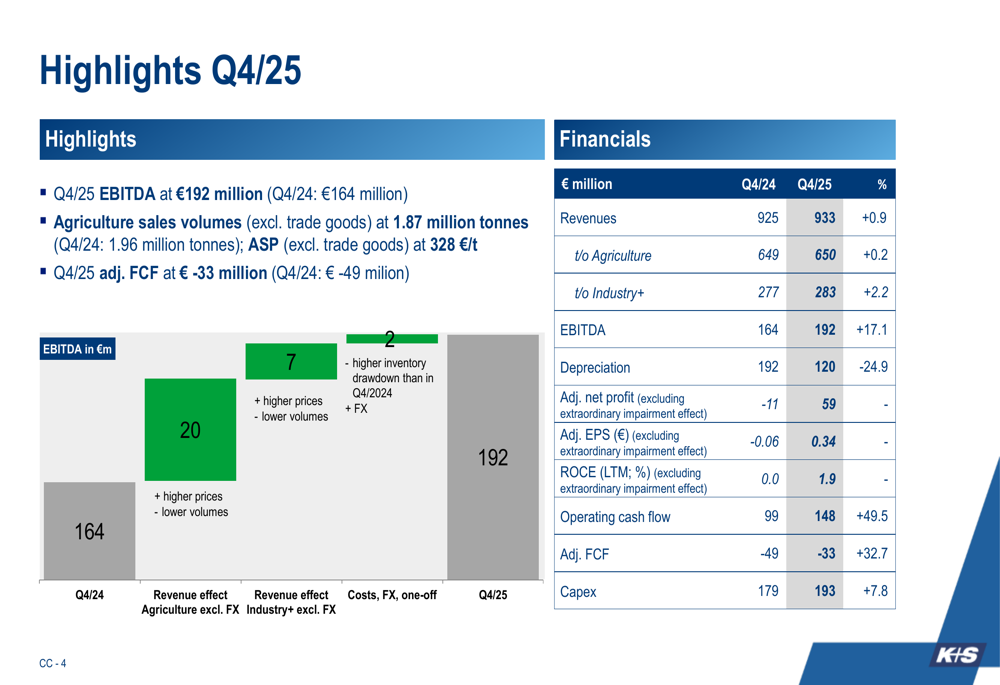
K+S FY 2025 slides: EBITDA rises 17% as specialty focus pays off
#K+S #EBITDA #FY 2025 #specialty focus #financial growth
📌 Key Takeaways
- K+S reported a 17% increase in EBITDA for FY 2025.
- The growth is attributed to the company's strategic focus on specialty products.
- The results were presented in the company's FY 2025 slides.
- The specialty focus is delivering positive financial outcomes.
🏷️ Themes
Financial Performance, Corporate Strategy
📚 Related People & Topics
Earnings before interest, taxes, depreciation and amortization
Accounting measure of a company's profitability
Earnings before interest, taxes, depreciation, and amortization, commonly known as EBITDA ( EE-bit-dah, EB-it-dah), is a measure of a company's profitability of the operating business only, thus before any effects of indebtedness, state-mandated payments, and costs required to maintain its asset bas...
Entity Intersection Graph
Connections for Earnings before interest, taxes, depreciation and amortization:
Mentioned Entities
Deep Analysis
Why It Matters
This news matters because K+S, a major global potash and salt producer, demonstrates that its strategic shift toward higher-margin specialty products is yielding significant financial results. The 17% EBITDA increase signals improved profitability and operational efficiency, which affects investors, competitors in the fertilizer industry, and agricultural customers who rely on these products. Strong performance in specialty segments could influence market pricing and competitive dynamics in the global fertilizer sector.
Context & Background
- K+S is a German-based company and one of the world's largest producers of potash and magnesium products, with operations in Europe and North America.
- The company has been undergoing a strategic transformation to focus more on specialty fertilizers and industrial salt products rather than commodity-grade potash.
- Global fertilizer markets have experienced volatility in recent years due to geopolitical tensions, supply chain disruptions, and fluctuating agricultural demand.
- K+S previously faced challenges including high debt levels and competitive pressure from larger producers like Nutrien and Mosaic.
What Happens Next
Investors will watch for K+S's detailed financial report and management commentary on future guidance. The company may continue investing in specialty product capacity or consider strategic partnerships. Market analysts will assess whether this growth trajectory can be sustained amid potential economic headwinds in agriculture.
Frequently Asked Questions
The 17% EBITDA growth indicates improved operational profitability and suggests the company's strategic focus on higher-margin specialty products is working effectively. This metric shows better earnings before interest, taxes, depreciation, and amortization, reflecting stronger core business performance.
Specialty fertilizers and industrial products typically command higher margins than commodity potash, providing better profitability and insulation from price volatility. This strategic shift helps K+S differentiate itself in competitive global markets and reduce dependence on cyclical agricultural commodity pricing.
Customers may see continued availability of specialized fertilizer products tailored to specific agricultural needs, though pricing could reflect the premium nature of these offerings. Farmers using specialty products might benefit from more targeted nutrient solutions despite potentially higher costs.
Potential challenges include global economic conditions affecting agricultural spending, competitive responses from larger fertilizer producers, and input cost inflation. Regulatory changes and environmental considerations around mining operations could also impact future performance.