

Listen live: Supreme Court weighs Trump's restrictions on birthright citizenship
📖 Full Retelling
📚 Related People & Topics
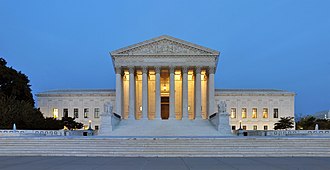
Supreme court
Highest court in a jurisdiction
In most legal jurisdictions, a supreme court, also known as a court of last resort, apex court, high (or final) court of appeal, and court of final appeal, is the highest court within the hierarchy of courts. Broadly speaking, the decisions of a supreme court are binding on all other courts in a nat...

Donald Trump
President of the United States (2017–2021; since 2025)
Donald John Trump (born June 14, 1946) is an American politician, media personality, and businessman who is the 47th president of the United States. A member of the Republican Party, he served as the 45th president from 2017 to 2021. Born into a wealthy New York City family, Trump graduated from the...
Entity Intersection Graph
Connections for Supreme court:
Mentioned Entities
Deep Analysis
Why It Matters
This case directly challenges the 14th Amendment's guarantee that 'all persons born or naturalized in the United States... are citizens,' potentially affecting millions of children born to undocumented immigrants. It tests the balance between presidential authority and constitutional protections, with implications for immigration policy and family unity. The outcome could reshape American demographics and legal status for generations, making it crucial for immigrant communities, policymakers, and constitutional scholars.
Context & Background
- The 14th Amendment was ratified in 1868 to guarantee citizenship to formerly enslaved people and their descendants, establishing birthright citizenship as a constitutional right.
- Birthright citizenship has been upheld for over 150 years, including in the 1898 Supreme Court case United States v. Wong Kim Ark, which affirmed citizenship for children born to non-citizen parents.
- Previous attempts to restrict birthright citizenship through legislation or executive action have faced significant legal challenges and constitutional scrutiny.
- The current case stems from executive orders issued during the Trump administration seeking to limit citizenship to children of U.S. citizens or lawful permanent residents.
What Happens Next
The Supreme Court will hear oral arguments, then deliberate before issuing a ruling likely by June 2024. Depending on the decision, Congress may consider legislation to either codify or restrict birthright citizenship. The ruling could trigger immediate legal challenges and affect pending immigration cases nationwide.
Frequently Asked Questions
Birthright citizenship, also called jus soli, is the legal principle that anyone born within a country's territory automatically gains citizenship, regardless of their parents' immigration status. In the U.S., this has been protected by the 14th Amendment since 1868.
If the Court upholds restrictions, it would not affect those already granted citizenship but could create uncertainty about future challenges to citizenship status. It might also create a two-tier system where some citizens have more secure status than others.
The United States, Canada, and most Latin American countries have birthright citizenship, while many European and Asian nations require at least one parent to be a citizen or legal resident. The U.S. has one of the world's strongest birthright citizenship traditions.
Proponents argue restrictions would reduce 'birth tourism' and unauthorized immigration, while opponents contend they violate the 14th Amendment's plain language and could create a permanent underclass of undocumented residents.
Most legal scholars believe Congress cannot override the 14th Amendment's citizenship clause through ordinary legislation, though some argue Congress has power to define 'subject to the jurisdiction thereof.' A constitutional amendment would require two-thirds of both houses and three-fourths of states.