
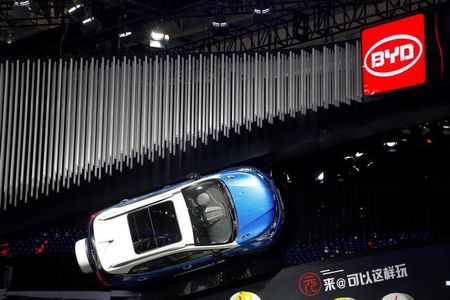
Macquarie on BYD showcasing Flash Charging technology at Shenzhen headquarters
#BYD #Flash Charging #Macquarie #Shenzhen #electric vehicles #charging technology #headquarters #demonstration
📌 Key Takeaways
- BYD showcased its Flash Charging technology at its Shenzhen headquarters.
- The technology aims to significantly reduce electric vehicle charging times.
- Macquarie analysts observed the demonstration and provided insights.
- The event highlights BYD's focus on advancing EV infrastructure and innovation.
🏷️ Themes
Electric Vehicles, Technology Innovation
📚 Related People & Topics

Shenzhen
City in Guangdong, China
Shenzhen is a prefecture-level city in the province of Guangdong, China. A special economic zone, it is located on the east bank of the Pearl River estuary on the central coast of Guangdong, bordering Hong Kong to the south, Dongguan to the north, Huizhou to the northeast, and Macau to the southwest...
Entity Intersection Graph
Connections for Macquarie:
Mentioned Entities
Deep Analysis
Why It Matters
BYD's Flash Charging technology demonstration matters because it addresses one of the biggest barriers to widespread EV adoption - charging time anxiety. This affects EV manufacturers competing in the global market, consumers considering electric vehicle purchases, and governments investing in charging infrastructure. The technology could significantly reduce charging times, making EVs more practical for long-distance travel and urban use. As the world's largest EV manufacturer, BYD's advancements influence global automotive trends and competitive dynamics in the sustainable transportation sector.
Context & Background
- BYD surpassed Tesla as the world's largest EV manufacturer by sales volume in Q4 2023
- China is the world's largest EV market, accounting for approximately 60% of global EV sales
- Fast charging technology has been a key competitive battleground among EV manufacturers, with companies like Tesla, Nio, and XPeng developing proprietary systems
- BYD previously announced its 'Blade Battery' technology in 2020, which improved safety and energy density
- The Chinese government has set ambitious targets for EV adoption, aiming for new energy vehicles to comprise 40% of total car sales by 2030
What Happens Next
BYD will likely begin integrating Flash Charging technology into upcoming vehicle models within 12-18 months, with potential announcements at major auto shows. The company may expand charging infrastructure partnerships in China and internationally. Competitors will respond with their own fast-charging announcements, potentially accelerating industry-wide charging improvements. Regulatory bodies may establish new standards for ultra-fast charging systems as this technology becomes more widespread.
Frequently Asked Questions
While exact specifications weren't provided in the announcement, Flash Charging likely represents a significant improvement over BYD's current 80% charge in 30 minutes capability. It probably approaches or exceeds competitors' fastest systems like Tesla's V3 Supercharging or Nio's battery swap technology in terms of time efficiency.
Most existing BYD vehicles probably won't be compatible with the full Flash Charging capability due to different battery architectures and charging system requirements. However, some recent models might receive limited upgrades through software updates or hardware modifications at service centers.
Flash Charging strengthens BYD's technological competitiveness, particularly in the Chinese market where charging infrastructure is rapidly expanding. It addresses a key consumer concern and could help BYD maintain its sales leadership while potentially gaining market share in premium segments where charging convenience is crucial.
Ultra-fast charging can cause increased battery degradation over time due to heat generation during rapid energy transfer. It also requires specialized charging infrastructure with higher power capacity, which may be limited in availability and more expensive to deploy compared to standard charging stations.
BYD will likely deploy Flash Charging technology in key international markets where it has strong presence, particularly Europe and Southeast Asia. However, rollout timing will depend on local infrastructure development, regulatory approvals, and partnership agreements with charging network operators in each region.