Morning Bid: Trump fumes against the world as his tariffs come up short
#Trump tariffs#Supreme Court#Trade agreements#AI disruption#Asian markets#Safe haven assets#State of the Union#Export restrictions
📌 Key Takeaways
Supreme Court struck down Trump's emergency tariffs, prompting warnings to trade partners
Asian governments seek assurances about existing trade terms with the US
China imposed export restrictions on Japanese entities with alleged military links
AI supply chain stocks drove Asian markets to new highs despite trade tensions
📖 Full Retelling
US President Donald Trump warned trade partners not to 'play games' by backing out of recently agreed trade deals in Washington on February 24, 2026, after the Supreme Court struck down his emergency tariffs, with Asian governments including Japan and Taiwan seeking assurances about existing agreements. Trump is expected to 'come out swinging' during his annual State of the Union address later on Tuesday, potentially targeting Supreme Court Justices seated in the chamber as he reacts to the significant policy setback. Meanwhile, Japan has inquired whether its treatment under a new U.S. tariff regime will remain as favorable as last year's agreement, while Taiwan's government has sought similar guarantees about terms already negotiated. Adding to the geopolitical tensions, China prohibited the export of dual-use items to 20 Japanese entities with alleged military links, citing efforts to curb Japan's 'remilitarization,' though markets in both countries largely shrugged off the dispute. Asian markets rebounded strongly, with the Nikkei 225 and CSI 300 both gaining over 1% as they reopened after local holidays and processed the reduced tariff impact, while manufacturers in the AI supply chain propelled benchmarks in Taiwan and South Korea to fresh highs, sending MSCI's broadest Asia-Pacific index outside Japan to a record level. The market turbulence followed Wall Street's slide on Monday, which some analysts attributed to a 'doomsday' AI research report that presented a vision of potential economic havoc from artificial intelligence, though U.S. S&P 500 e-mini futures recovered modestly in early trading.
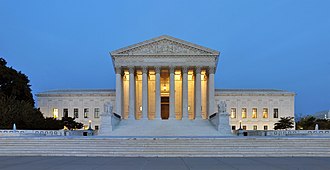
In most legal jurisdictions, a supreme court, also known as a court of last resort, apex court, high (or final) court of appeal, and court of final appeal, is the highest court within the hierarchy of courts. Broadly speaking, the decisions of a supreme court are binding on all other courts in a nat...
A trade agreement (also known as trade pact) is a wide-ranging taxes, tariff and trade treaty that often includes investment guarantees. It exists when two or more countries agree on terms that help them trade with each other. The most common trade agreements are of the preferential and free trade t...
This news matters because it highlights significant global trade tensions following a U.S. Supreme Court decision that struck down President Trump's emergency tariffs. The situation creates uncertainty for international trade relationships and could impact global markets. The developments also show how trade policy disputes can quickly escalate into broader geopolitical tensions.
Context & Background
Supreme Court struck down Trump's emergency tariffs
Trump warning trade partners not to 'play games'
China restricting exports to Japanese entities
Asian markets reacting positively to lower tariffs
Wall Street experienced selloff attributed to AI research report
What Happens Next
Trump is expected to 'come out swinging' during his State of the Union address later on Tuesday. Markets will be watching for any new trade policy announcements or retaliatory measures. The situation may lead to further trade negotiations or potential retaliatory actions from affected countries.
Frequently Asked Questions
What was the Supreme Court's decision regarding Trump's tariffs?
The Supreme Court struck down President Trump's emergency tariffs, creating uncertainty about existing trade agreements.
How are Asian markets reacting to the tariff developments?
Asian markets, particularly Japan and China, are gaining from lower U.S. tariffs as they reopen after local holidays.
What is China's response to the trade developments?
China has prohibited exports of dual-use items to 20 Japanese entities it claims have military links.
What caused the Wall Street selloff mentioned in the article?
Some analysts attributed the selloff to a 'doomsday' analysis from Citrini Research about AI's potential impact on the global economy.
}
Original Source
try{ var _=i o; . if(!_||_&&typeof _==="object"&&_.expiry Asia stocks rise as China reopens on a strong note; Hong Kong hit by tech losses Wall Street slides on Trump tariff turmoil, AI disruption research report Dystopian AI report sinks payment and software stocks Gold prices rise as Trump tariff turmoil boosts safe haven demand (South Africa Philippines Nigeria) Morning Bid: Trump fumes against the world as his tariffs come up short By Reuters Economy Published 02/24/2026, 12:44 AM Updated 02/24/2026, 12:54 AM Morning Bid: Trump fumes against the world as his tariffs come up short 0 JP225 0.94% TEF 1.96% HD -1.38% ESH26 0.18% ELE 1.72% GB7YT=RR -0.89% WDAY -6.24% MIAPJ0000PUS 0.34% CSI300 1.07% FDXMc1 0.17% LXZc1 0.00% A look at the day ahead in European and global markets from Gregor Stuart Hunter Is this the Art of the Deal? U.S. President Donald Trump has warned trade partners not to "play games" by backing out of recently agreed trade deals after the Supreme Court struck down his emergency tariffs. But some foreign governments just want to know if the terms they originally negotiated are still good. Trump is expected to "come out swinging" during his annual State of the Union address later on Tuesday after the tariff setback, and may take aim at some of the Supreme Court Justices seated in the chamber. But governments in Asia have questions. Japan wants to know whether the nation’s treatment under a new U.S. tariff regime will be as favourable as an agreement reached between the two sides last year. And Taiwan’s government is seeking assurances from the U.S. that the beneficial terms it has already agreed do not change. Not to be outdone by the trade drama in Washington, China on Tuesday prohibited the export of dual-use items to 20 Japanese entities that it says have military links, aimed at curbing Japan’s "remilitarisation". Markets in Japan and China largely shrugged off the dispute, gaining a boost from lower U.S. tariffs as they reopened after local hol...