
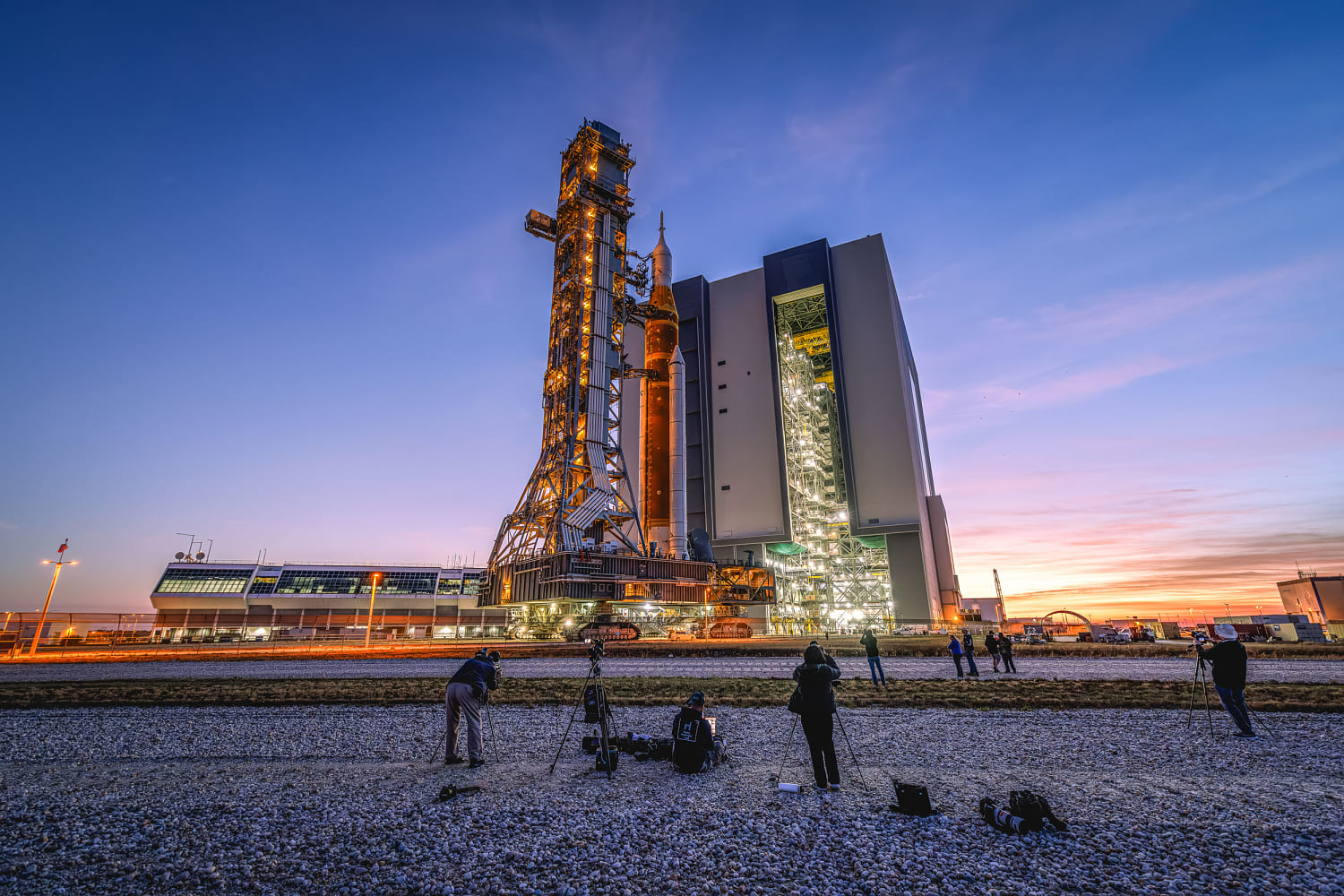
NASA to roll its moon rocket back to the launchpad after repairs, aiming for April 1 liftoff
#NASA #moon rocket #launchpad #repairs #April 1 #liftoff #lunar mission
📌 Key Takeaways
- NASA's moon rocket is returning to the launchpad following repairs.
- The agency is targeting an April 1 liftoff for the mission.
- This move indicates progress after previous technical issues.
- The mission is part of NASA's lunar exploration program.
📖 Full Retelling
🏷️ Themes
Space Exploration, Rocket Launch
📚 Related People & Topics

NASA
American space and aeronautics agency
The National Aeronautics and Space Administration (NASA ) is an independent agency of the U.S. federal government responsible for the United States' civil space program and for research in aeronautics and space exploration. Headquartered in Washington, D.C., NASA operates ten field centers across th...
Entity Intersection Graph
Connections for NASA:
Mentioned Entities
Deep Analysis
Why It Matters
This development is crucial because it represents a major step in NASA's Artemis program, which aims to return humans to the Moon for the first time since 1972. The successful launch would demonstrate the viability of NASA's new Space Launch System (SLS) rocket and Orion spacecraft, paving the way for future crewed missions. This affects NASA's international partners, commercial space companies, and the scientific community who depend on lunar exploration for research and technology development. A successful mission would also reinforce U.S. leadership in space exploration amid growing global competition.
Context & Background
- The Artemis program was announced in 2017 with the goal of landing 'the first woman and the next man' on the Moon by 2024, though timelines have since been adjusted.
- The Space Launch System (SLS) rocket has faced multiple delays and budget overruns since its development began in 2011, with its first uncrewed test flight originally planned for 2017.
- NASA's previous attempt to launch Artemis I in 2022 was scrubbed multiple times due to technical issues including hydrogen leaks and engine cooling problems.
- The Orion spacecraft, designed for deep space missions, previously completed an uncrewed test flight in 2014 using a Delta IV Heavy rocket.
- International partners including ESA, JAXA, and CSA are contributing to Artemis through modules, robotics, and astronaut participation.
What Happens Next
NASA will conduct a wet dress rehearsal in mid-March to fully fuel the rocket and practice countdown procedures. If successful, the April 1 launch window opens for approximately two weeks. Following launch, the uncrewed Orion spacecraft will spend approximately 25.5 days in space, including a distant retrograde orbit around the Moon before returning to Earth. NASA will analyze mission data for several months before proceeding with Artemis II, the first crewed mission currently scheduled for 2025.
Frequently Asked Questions
This Artemis I mission serves as a critical test of both the SLS rocket and Orion spacecraft systems before risking human lives. The data collected will validate safety systems, radiation protection, and re-entry capabilities essential for future crewed missions to the Moon and eventually Mars.
Previous launch attempts were scrubbed due to multiple technical issues including hydrogen fuel leaks in quick-disconnect interfaces, faulty temperature sensors in rocket engines, and weather concerns including lightning strikes near the launchpad. These required extensive troubleshooting and component replacements.
Artemis aims for sustainable lunar exploration with international and commercial partnerships, focusing on the Moon's south pole where water ice may exist. Unlike Apollo's short visits, Artemis plans to establish a permanent lunar gateway and base for long-term human presence and Mars mission preparation.
NASA has backup launch windows in April and May, with the next favorable orbital mechanics occurring in summer 2023. Extended delays would impact the entire Artemis timeline, potentially pushing back the crewed Artemis II mission and subsequent lunar landing attempts.
The SLS was developed through NASA contracts with multiple aerospace companies: Boeing built the core stage, Northrop Grumman the solid rocket boosters, Lockheed Martin the Orion capsule, and Aerojet Rocketdyne the RS-25 engines. European Space Agency contributed the Orion service module.